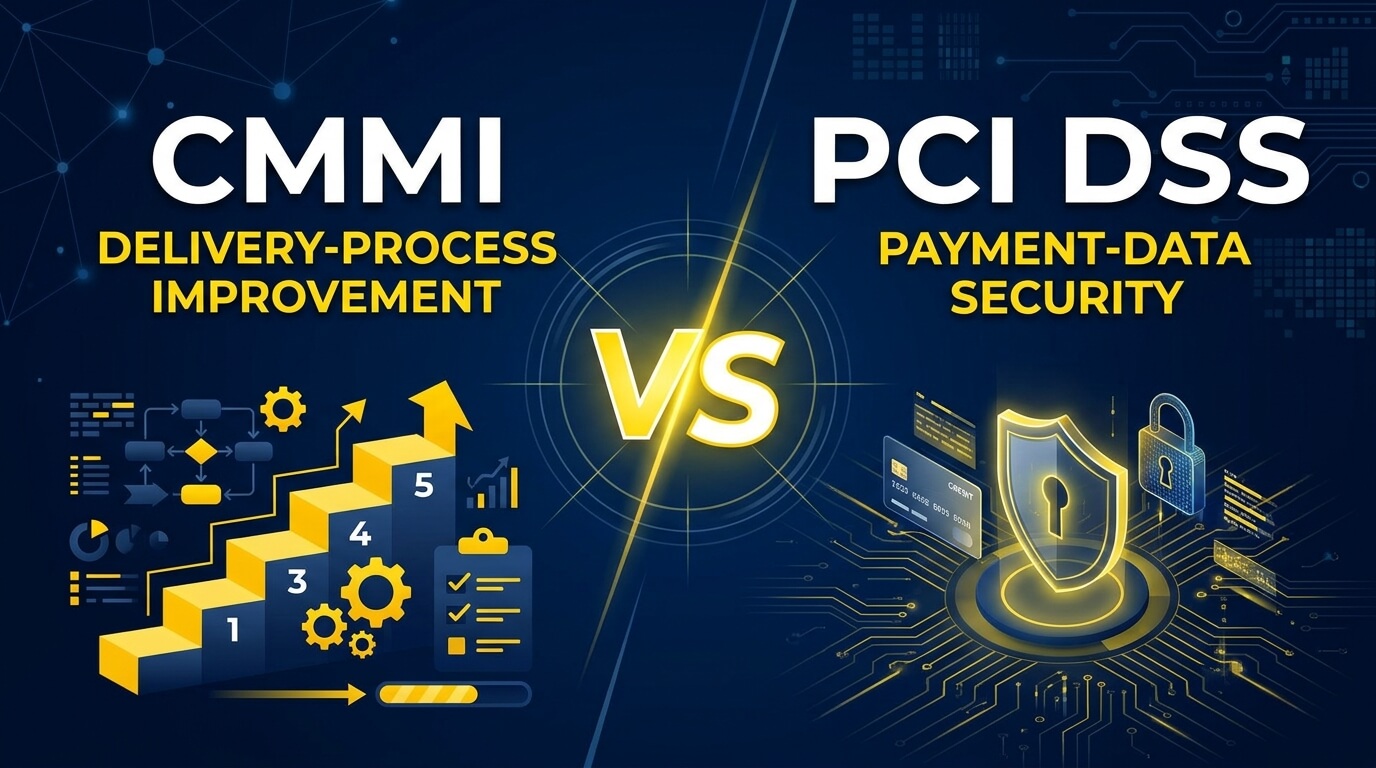
CMMI focuses on improving organizational capability, process consistency, and business performance. PCI DSS establishes technical and operational security requirements for environments that store, process, or transmit payment account data. Although both frameworks can contribute to stronger governance, risk management, and operational discipline, they have different objectives, assessment approaches, and outcomes.
This guide explains the differences between CMMI and PCI DSS through a side-by-side comparison, practical business scenarios, evidence-mapping considerations, and a decision guide. It also explains where the frameworks overlap, what evidence may be partially reusable, and why achieving an outcome under one framework does not establish compliance with the other.
1. What Is CMMI?
Capability Maturity Model Integration (CMMI) is a performance improvement framework that helps organizations build, evaluate, and improve their capabilities. It provides structured practices that organizations can use to strengthen the way they plan work, develop products, deliver services, manage suppliers, maintain quality, and achieve business objectives.
Rather than prescribing a single technical security configuration, CMMI encourages organizations to establish effective, repeatable, measurable, and continuously improving processes. Its practices can be applied across different industries and organizational environments, including software engineering, IT services, financial services, manufacturing, and other business operations.
CMMI Maturity Levels
CMMI maturity levels describe an organization's progress in building and improving its processes:
- Level 1 – Initial: Processes are often unpredictable, reactive, and inconsistent.
- Level 2 – Managed: Projects and work activities are planned, performed, monitored, and controlled.
- Level 3 – Defined: Organization-wide standards and processes guide work across projects and teams.
- Level 4 – Quantitatively Managed: Performance is measured and controlled using quantitative techniques and data.
- Level 5 – Optimizing: The organization focuses on continuous improvement, process optimization, and responding effectively to change.
A CMMI appraisal evaluates how an organization's processes align with the relevant model practices and appraisal objectives. Depending on the appraisal type and scope, an organization may receive a maturity-level or capability-level result. CMMI is therefore useful for organizations seeking measurable improvements in delivery performance, quality, productivity, and operational consistency.
2. What Is PCI DSS?
The Payment Card Industry Data Security Standard (PCI DSS) is a security standard developed and maintained by the PCI Security Standards Council (PCI SSC). It provides technical and operational requirements designed to protect payment account data throughout its handling lifecycle.
PCI DSS applies to entities that store, process, or transmit cardholder data (CHD) and/or sensitive authentication data (SAD), as well as entities that can affect the security of the cardholder data environment (CDE). Depending on their activities and responsibilities, this may include merchants, payment processors, financial institutions, and service providers.
The standard addresses areas such as network security, account-data protection, vulnerability management, secure software development, access control, monitoring, testing, and information security governance. Its objective is to reduce the risk of payment-data compromise through defined security requirements and validation activities.
PCI DSS Requirements at a Glance
PCI DSS v4.0.1 organizes its principal requirements into 12 areas:
- Install and maintain network security controls.
- Apply secure configurations to all system components.
- Protect stored account data.
- Protect cardholder data with strong cryptography during transmission over open, public networks.
- Protect systems and networks from malicious software.
- Develop and maintain secure systems and software.
- Restrict access to system components and cardholder data by business need to know.
- Identify users and authenticate access to system components.
- Restrict physical access to cardholder data.
- Log and monitor all access to system components and cardholder data.
- Test security of systems and networks regularly.
- Support information security with organizational policies and programs.
The applicable requirements depend on the organization's role, environment, payment-data flows, and assessment scope. Organizations should consult the current PCI SSC documentation and, where appropriate, a qualified assessor or their acquiring bank to determine the applicable validation route.
3. CMMI vs PCI DSS: Side-by-Side Comparison
The central difference in CMMI vs PCI DSS is their primary purpose. CMMI evaluates organizational capability and process performance, while PCI DSS defines security requirements for protecting payment account data. The following table highlights their key differences.
| Comparison Area |
CMMI |
PCI DSS |
| Primary purpose | Improve organizational capability, process maturity, and business performance. | Protect payment account data through defined security controls. |
| Main focus | Process management, delivery consistency, quality, measurement, and improvement. | Payment-data security, access control, system protection, monitoring, and testing. |
| Developed and maintained by | CMMI Institute, part of ISACA. | PCI Security Standards Council (PCI SSC). |
| Applicability | Organizations seeking to improve capability and performance across relevant business areas. | Entities handling payment account data or affecting the security of the cardholder data environment. |
| Assessment focus | Implementation of model practices and organizational capability. | Implementation and testing of applicable PCI DSS requirements. |
| Typical evidence | Process documentation, plans, performance measures, records, and implementation evidence. | Configurations, access records, security logs, vulnerability results, policies, and technical testing evidence. |
| Outcome | A maturity-level or capability-level appraisal result, depending on the appraisal. | A compliance assessment outcome and applicable validation documentation, such as an ROC or SAQ and AOC where relevant. |
| Technical security controls | May support effective management of security-related processes, but does not prescribe all PCI DSS controls. | Defines specific security requirements for the in-scope payment environment. |
| Continuous improvement | A central focus of the framework. | Requires ongoing maintenance and monitoring of applicable security controls and compliance activities. |
| Best suited for | Organizations improving delivery processes, operational capability, and performance. | Organizations that need to protect payment account data and demonstrate applicable PCI DSS compliance. |
4. Where Do CMMI and PCI DSS Overlap?
Although CMMI and PCI DSS have different objectives, they can reinforce each other in several operational areas. Both benefit from clearly assigned responsibilities, documented procedures, consistent implementation, evidence of execution, and management oversight.
4.1 Process Documentation and Governance
CMMI encourages organizations to establish and use defined processes. PCI DSS also requires documented policies, procedures, and responsibilities for applicable security activities. An organization with mature documentation practices may find it easier to organize PCI DSS policies, operational procedures, and evidence. However, documentation must still address the specific PCI DSS requirement and be implemented in practice.
4.2 Risk and Issue Management
Both frameworks can support disciplined risk and issue management. CMMI helps organizations establish consistent approaches to planning, monitoring, and addressing process-related risks. PCI DSS requires security-related activities that identify, address, and monitor risks to payment account data and the cardholder data environment. The terminology and assessment expectations may differ, so organizations should map each requirement carefully.
4.3 Training and Defined Responsibilities
Effective process implementation depends on people understanding their responsibilities. CMMI can help establish workforce and organizational practices, while PCI DSS includes security awareness and role-related responsibilities. Existing training administration and responsibility records may support both programs, but PCI DSS-specific security awareness content and evidence must be addressed separately where required.
4.4 Measurement, Monitoring, and Improvement
CMMI emphasizes performance measurement and improvement. PCI DSS requires applicable logging, monitoring, testing, and compliance-maintenance activities. Both can benefit from reliable records and management review, but a process-performance dashboard is not automatically proof that technical security monitoring meets PCI DSS requirements.
5. What CMMI Does Not Prove About PCI DSS—and Vice Versa
CMMI and PCI DSS are not equivalent, interchangeable, or substitutes for one another. Each framework has its own purpose, criteria, scope, evidence expectations, and assessment approach. An organization must not use an achievement under one framework as automatic proof of compliance or achievement under the other.
A CMMI Appraisal Does Not Establish PCI DSS Compliance
An organization may achieve a CMMI Maturity Level 3 or Level 5 appraisal result and still have gaps in payment-data security. A CMMI appraisal does not, by itself, verify that the organization has implemented all applicable PCI DSS requirements, such as network security controls, encryption, access restrictions, vulnerability management, or payment-environment monitoring.
For example, a software company may have standardized development and service delivery processes but still fail to secure its cardholder data environment. Its CMMI result cannot be presented as evidence that it has passed a PCI DSS assessment.
PCI DSS Compliance Does Not Establish CMMI Maturity
Similarly, an organization that meets PCI DSS requirements has not automatically demonstrated CMMI maturity. PCI DSS compliance does not establish that its projects consistently follow defined processes, that delivery performance is quantitatively managed, or that organizational processes are optimized for continuous improvement.
A payment service provider may have strong technical controls and a successful PCI DSS assessment while continuing to experience inconsistent project planning, delayed releases, recurring defects, or weak delivery predictability. Those performance challenges require their own improvement approach.
Important: CMMI maturity is not a substitute for PCI DSS compliance, and PCI DSS compliance is not proof of CMMI maturity. Organizations should pursue each framework according to its actual business, contractual, operational, and security requirements.
6. Evidence Mapping: Equivalent vs Partially Reusable Evidence
Organizations implementing both frameworks may be able to reduce duplication by coordinating documentation, responsibilities, and evidence collection. However, evidence reuse must be based on the actual requirement, not merely on similar terminology. A document that supports a CMMI practice may provide useful context for PCI DSS, but it is not automatically sufficient to demonstrate PCI DSS compliance.
| Evidence or Activity |
Potential CMMI Relevance |
Potential PCI DSS Relevance |
Reuse Consideration |
| Approved organizational policies | Supports defined and governed processes. | May support applicable information security policies. | Partially reusable; PCI DSS-specific policy content and approval evidence must be checked. |
| Training records | Supports workforce capability and process implementation. | May support applicable security awareness requirements. | Partially reusable; subject matter, audience, timing, and coverage must align. |
| Risk registers | Supports planning and management of process risks. | May support security risk activities and governance. | Partially reusable; PCI DSS-specific scope and risk analysis remain necessary. |
| Change management records | Supports controlled process and project changes. | May support applicable system and network change controls. | Partially reusable; technical approval, testing, and security impact evidence may be required. |
| Performance dashboards | Supports measurement and performance improvement. | May provide management context for compliance monitoring. | Usually supporting evidence only; it does not replace required technical logs or testing. |
| Vulnerability scan reports | May inform risk and process improvement activities. | Can provide direct evidence for applicable PCI DSS testing requirements when performed correctly. | Potentially reusable as supporting evidence, subject to scope, methodology, timing, and assessor requirements. |
| Access review records | May support controlled work practices and responsibilities. | May directly support applicable access-control requirements. | Partially reusable; account coverage, authorization, frequency, and CDE scope must be verified. |
| Process improvement plans | Directly relevant to CMMI improvement activities. | May support remediation planning and compliance governance. | Supporting evidence only unless it also demonstrates the specific required security activity. |
The distinction is important: administrative evidence may sometimes be reused, but technical compliance evidence must meet the relevant PCI DSS testing and validation expectations. A shared policy or procedure does not prove that the associated control is operating effectively. Evidence must be current, complete, traceable, and relevant to the assessment scope.
7. Practical Business Scenarios: When Should Organizations Choose Each Framework?
Scenario 1: Software Development Company Experiencing Delivery Problems
A software development organization regularly misses delivery deadlines, experiences recurring defects, and struggles to maintain consistent project practices. Its primary challenge is process performance rather than payment-data security.
Recommended direction: CMMI may be the more relevant starting point. It can help the organization improve planning, engineering practices, quality management, measurement, and delivery consistency. PCI DSS would become relevant if the organization also handles payment account data or affects the security of a payment environment.
Scenario 2: E-Commerce Business Handling Card Payments
An online retailer accepts card payments and operates systems that store, process, or transmit payment account data. Its priority is to protect customer payment information and meet applicable payment security obligations.
Recommended direction: PCI DSS should be prioritized. The organization must establish its payment-data scope, identify applicable requirements, implement the required controls, and follow the relevant assessment and validation process. CMMI may provide additional value if the retailer also wants to improve software delivery, IT operations, or organizational performance.
Scenario 3: Payment Gateway or Payment Service Provider
A payment service provider manages payment infrastructure, supports merchants, and develops software used in transaction processing. It needs to protect payment data while maintaining reliable service delivery and predictable software development processes.
Recommended direction: Both frameworks may be valuable. PCI DSS addresses the applicable payment-data security obligations, while CMMI can strengthen development, service management, quality, and delivery performance. The organization should define separate but coordinated scopes for each program.
Scenario 4: IT Service Provider Supporting a Financial Institution
An IT service provider supports a bank or payment organization. It does not necessarily store or process cardholder data directly, but its systems, services, or access may affect the security of the customer's cardholder data environment.
Recommended direction: The provider should first establish whether it falls within PCI DSS scope based on its actual services, access, and impact on the CDE. Contractual obligations and customer security requirements also matter. CMMI may help improve service delivery and operational capability, but it does not determine PCI DSS applicability or remove a provider from scope.
Scenario 5: Fintech Company Scaling Its Operations
A fintech company is expanding into new markets, increasing transaction volumes, adding development teams, and introducing new payment channels. It must maintain secure payment operations while improving its ability to deliver products and services consistently.
Recommended direction: A coordinated CMMI and PCI DSS strategy may be appropriate. PCI DSS should address applicable payment-data protection requirements, while CMMI can support scalable processes, performance measurement, and continuous improvement. The implementation plan should avoid assuming that success in one program automatically satisfies the other.
8. CMMI vs PCI DSS: Decision Guide
The right framework depends on the organization's business objectives, payment-data responsibilities, customer expectations, and operational challenges. Use the following decision table to identify the most relevant direction.
| Business Requirement or Challenge |
Recommended Framework |
Reason |
| Improve software development processes. | CMMI | Focuses on engineering capability and consistent process implementation. |
| Improve service delivery and operational performance. | CMMI | Supports process management, measurement, and performance improvement. |
| Protect cardholder data. | PCI DSS | Defines security requirements for payment account data environments. |
| Meet applicable payment-card security obligations. | PCI DSS | Provides the relevant requirements and validation framework. |
| Reduce recurring development defects and delivery delays. | CMMI | Helps strengthen processes and measurable delivery performance. |
| Improve payment security and delivery performance together. | Both | The frameworks address complementary but distinct business needs. |
| Demonstrate organizational process maturity to customers. | CMMI | A relevant appraisal result can communicate assessed organizational capability. |
| Validate security controls in an in-scope payment environment. | PCI DSS | Requires assessment against applicable payment-data security requirements. |
Questions to Ask Before Selecting a Framework
- Does the organization store, process, or transmit payment account data?
- Can the organization's systems or services affect the security of a cardholder data environment?
- Are delivery delays, inconsistent processes, quality issues, or unpredictable performance major business challenges?
- Do customers, payment partners, or contracts require a specific security validation or process maturity outcome?
- Does the organization need stronger payment security, better delivery processes, or both?
- Can existing policies, records, and technical evidence be mapped to specific requirements without treating them as automatically equivalent?
If payment-data protection is the primary obligation, begin with PCI DSS scope and applicability. If organizational delivery performance is the main challenge, consider a CMMI adoption and appraisal roadmap. If both objectives are important, establish an integrated implementation plan with distinct requirements, evidence owners, assessment criteria, and timelines.
9. Can Organizations Implement CMMI and PCI DSS Together?
Yes. Organizations can implement CMMI and PCI DSS as complementary initiatives. In fact, a coordinated approach can help reduce administrative duplication and improve visibility across governance, process management, and security operations. However, integration should not merge their assessment criteria or weaken framework-specific controls.
A practical integrated approach may include the following steps:
- Step 1 – Define business objectives: Identify whether the organization needs delivery-process improvement, payment-data security, or both.
- Step 2 – Establish separate scopes: Identify the organizational units, projects, services, systems, and payment environments relevant to each framework.
- Step 3 – Conduct gap assessments: Evaluate current processes against relevant CMMI practices and payment security controls against applicable PCI DSS requirements.
- Step 4 – Build a coordinated action plan: Assign owners, deadlines, resources, and measurable improvement objectives.
- Step 5 – Organize evidence: Maintain a structured evidence repository while preserving separate requirement-level traceability.
- Step 6 – Validate implementation: Use the appropriate CMMI appraisal approach and PCI DSS assessment or validation route for the organization's circumstances.
- Step 7 – Maintain and improve: Monitor process performance and maintain applicable security controls as ongoing operational activities.
This approach helps organizations use common governance structures where appropriate while preserving the technical and assessment-specific requirements of each framework.
10. Common Mistakes Organizations Should Avoid
Organizations comparing CMMI vs PCI DSS should avoid several common misunderstandings:
- Treating the frameworks as interchangeable: CMMI and PCI DSS have different objectives and cannot replace one another.
- Assuming a high CMMI maturity level proves payment security: A maturity-level appraisal does not validate all applicable PCI DSS controls.
- Assuming PCI DSS compliance proves process maturity: Payment-data security validation does not establish organizational delivery capability.
- Ignoring PCI DSS scope: Organizations must understand payment-data flows, connected systems, service-provider relationships, and potential security impact before determining applicable requirements.
- Reusing evidence without checking requirements: Similar documents do not necessarily meet different frameworks' evidence expectations.
- Focusing only on assessment preparation: Sustainable performance improvement and payment-data protection require ongoing operational commitment.
- Using outdated standards or guidance: Organizations should verify the current PCI DSS documents and applicable CMMI model and appraisal guidance before implementation.
11. How B-ADVANCY Can Support CMMI and Related Assurance Initiatives
Organizations working to improve delivery performance and strengthen information security may need a structured approach to framework selection, gap identification, implementation planning, and evidence management. B-ADVANCY Certification UK Limited supports organizations through certification, audit and inspection, consulting, and professional training services across relevant management-system and business-assurance areas.
For organizations considering CMMI, the appropriate support may include understanding business objectives, identifying relevant model domains, assessing process gaps, planning improvements, and preparing for the applicable appraisal pathway. For organizations addressing payment-data security, the priority is to understand PCI DSS applicability, define the cardholder data environment, identify relevant requirements, and plan appropriate security improvements and validation activities.
When multiple frameworks are involved, B-ADVANCY encourages a structured multi-framework scoping and controls-mapping discussion. The objective is to identify which evidence may be directly relevant to a requirement, which controls are only partially reusable, and which activities require separate implementation or validation. This helps organizations reduce unnecessary duplication without assuming that one framework's outcome satisfies another framework's requirements.
12. Frequently Asked Questions (FAQs)
1. What is the main difference between CMMI and PCI DSS?
CMMI focuses on improving organizational capability, process maturity, and business performance. PCI DSS focuses on protecting payment account data through defined technical and operational security requirements.
2. Is CMMI a replacement for PCI DSS?
No. CMMI does not replace PCI DSS. Organizations that fall within PCI DSS scope must address the applicable payment-data security requirements regardless of their CMMI appraisal results.
3. Does PCI DSS compliance prove CMMI maturity?
No. PCI DSS compliance demonstrates an assessment outcome against applicable payment security requirements. It does not establish that organizational processes meet CMMI maturity or capability expectations.
4. Can an organization implement CMMI and PCI DSS together?
Yes. Organizations can coordinate governance, documentation, responsibilities, training, and improvement activities. However, each framework must retain its own scope, requirements, evidence criteria, and assessment process.
5. Which organizations should consider CMMI?
Software developers, IT service providers, engineering organizations, and other businesses seeking to improve process consistency, delivery performance, quality, and organizational capability may consider CMMI.
6. Which organizations need to consider PCI DSS?
Entities that store, process, or transmit cardholder data or sensitive authentication data, and entities that can affect the security of the cardholder data environment, need to assess their PCI DSS applicability and obligations.
7. Can CMMI documentation be reused for PCI DSS?
Some documentation, such as policies, training records, risk records, and change-management procedures, may provide supporting evidence for both programs. However, reuse depends on whether the evidence meets the specific PCI DSS requirement, scope, timing, and testing expectations.
8. Does CMMI Level 5 mean an organization has strong payment security?
Not necessarily. CMMI Level 5 reflects an assessed level of organizational process maturity and optimization within the appraisal scope. It does not independently verify PCI DSS compliance or the effectiveness of all payment security controls.
9. What is the current PCI DSS version organizations should review?
Organizations should consult the PCI SSC website and document library for the current applicable PCI DSS version and supporting documents. PCI DSS v4.0.1 was published as a limited revision of v4.0. Always verify current guidance before beginning an assessment or compliance project.
10. Should an organization choose CMMI, PCI DSS, or both?
The decision depends on business objectives and payment-data responsibilities. Choose CMMI when process maturity and delivery performance are priorities, PCI DSS when payment-data security obligations apply, and both when the organization needs to address both sets of objectives.
13. Conclusion: Choosing the Right Framework for Business Performance and Payment Security
The comparison of CMMI vs PCI DSS is not about selecting one framework as a replacement for the other. It is about understanding two different organizational priorities. CMMI helps organizations improve how they plan, develop, manage, and deliver products and services. PCI DSS helps organizations protect payment account data through defined security requirements and validation activities.
For software development and IT service organizations, CMMI can provide a structured path toward stronger process capability, predictable delivery, and continuous improvement. For merchants, payment processors, fintech companies, and relevant service providers, PCI DSS addresses payment-data security responsibilities. Organizations with both operational and payment-security objectives may benefit from implementing the frameworks together through coordinated planning and carefully controlled evidence mapping.
The essential principle is clear: CMMI maturity does not establish PCI DSS compliance, and PCI DSS compliance does not establish CMMI maturity. Organizations should define their requirements, understand their scope, map evidence accurately, and validate each framework independently. A well-planned approach can strengthen business performance while supporting the protection of sensitive payment information.
Contact B-ADVANCY:
📞 WhatsApp: Chat on WhatsApp 📧 Email:info@b-advancy.com


 Contact For Services
 Explore Training Calendar