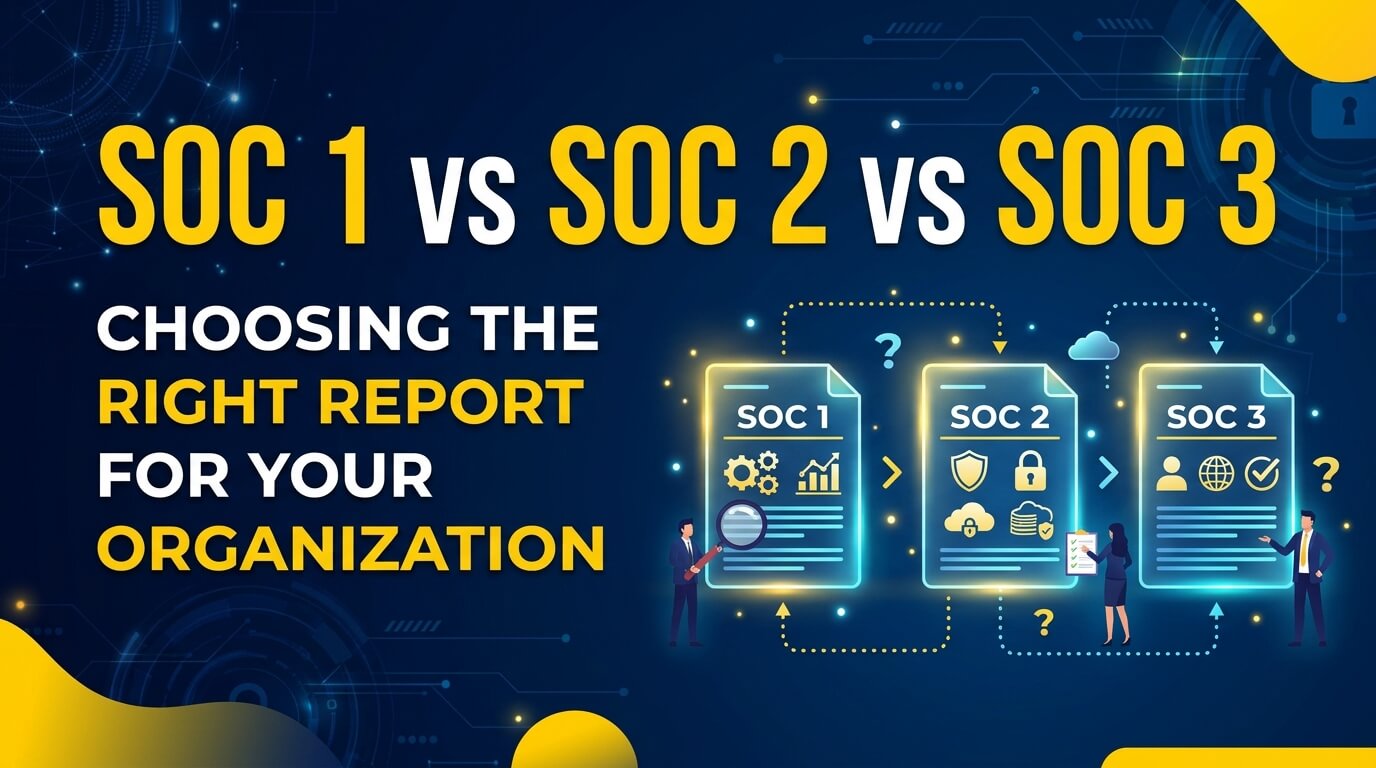
Organizations that provide outsourced services, cloud platforms, data processing, payroll, financial technology, hosting, or other business-critical solutions are increasingly expected to demonstrate that their internal controls are reliable. Customers, business partners, regulators, and auditors may request independent assurance about how a service organization manages financial reporting controls, information security, system availability, and sensitive data. This is where SOC reporting becomes important.
However, choosing between SOC 1, SOC 2, and SOC 3 can be confusing. Although all three belong to the American Institute of Certified Public Accountants (AICPA) System and Organization Controls (SOC) reporting suite, they are designed for different purposes and audiences. Selecting the wrong report may leave customer requirements unanswered, create unnecessary assessment work, or result in a report that does not provide the information stakeholders actually need.
Understanding SOC 1 vs SOC 2 vs SOC 3 requires more than comparing report names. Organizations must identify the services being provided, the risks associated with those services, the intended users of the report, and the type of assurance customers expect.
This guide explains the differences through a side-by-side comparison, practical business scenarios, and a decision guide. It also clarifies why SOC reports are not interchangeable certifications and why readiness support must remain distinct from an independent CPA examination.
1. What Are SOC 1, SOC 2, and SOC 3 Reports?
System and Organization Controls (SOC) reports are independent assurance reports designed to communicate information about an organization's controls. They help relevant stakeholders understand how a service organization manages controls associated with the services and systems it provides.
The three reports address different assurance needs:
- SOC 1: Focuses on controls at a service organization that are likely to be relevant to user entities' internal control over financial reporting (ICFR).
- SOC 2: Focuses on controls relevant to one or more AICPA Trust Services Criteria categories: security, availability, processing integrity, confidentiality, and privacy.
- SOC 3: Addresses the same general Trust Services Criteria subject matter as SOC 2 but provides a general-use report with less detailed information about the system and examination results.
The main distinction is the purpose and level of detail. SOC 1 is associated with financial reporting risks. SOC 2 provides detailed information about controls relevant to the selected Trust Services Criteria. SOC 3 offers a more accessible, general-use summary for audiences that do not require the detailed information contained in a SOC 2 report.
2. SOC 1 vs SOC 2 vs SOC 3: Side-by-Side Comparison
The following table highlights the primary differences organizations should consider before selecting a SOC reporting engagement.
| Comparison Area |
SOC 1 |
SOC 2 |
SOC 3 |
| Primary purpose |
Evaluate controls relevant to user entities' financial reporting. |
Evaluate controls relevant to selected Trust Services Criteria. |
Provide general-use assurance about controls relevant to the Trust Services Criteria. |
| Main focus |
Internal control over financial reporting (ICFR). |
Security, availability, processing integrity, confidentiality, and/or privacy. |
The same general Trust Services Criteria subject matter as SOC 2. |
| Typical audience |
Customers, user entities, controllers, and financial statement auditors. |
Customers, security teams, vendor risk teams, regulators, and business partners. |
Prospective customers, business partners, and general users. |
| Level of detail |
Detailed system description, controls, and examination information. |
Detailed system description, controls, tests, and results, as applicable to the report. |
Condensed information; detailed control testing information is not presented as in SOC 2. |
| Report distribution |
Generally restricted to specified users. |
Generally restricted to specified users. |
Designed for general use and broader distribution. |
| Type 1 / Type 2 |
Type 1 and Type 2 reports are available. |
Type 1 and Type 2 reports are available. |
A SOC 3 report is generally based on a SOC 2 Type 2 examination. |
| Typical business need |
Customers need assurance about outsourced financial reporting-related processes. |
Customers need detailed assurance about service security and related controls. |
An organization wants to communicate general assurance without distributing a detailed restricted-use report. |
| Certification? |
No. It is an independent attestation report. |
No. It is an independent attestation report. |
No. It is an independent attestation report. |
The comparison demonstrates that the three reports are not simply different levels of the same certification. Each has a distinct purpose, intended audience, and reporting approach. The right choice depends on the assurance question that customers or other intended users need answered.
3. Understanding SOC 1: Controls Relevant to Financial Reporting
A SOC 1 examination evaluates controls at a service organization that are likely to be relevant to its customers' internal control over financial reporting. It is particularly relevant when a service organization performs activities that may affect the financial records, transactions, or financial reporting processes of its customers.
When Is SOC 1 Appropriate?
SOC 1 may be appropriate when a service provider performs activities such as:
- Payroll processing and employee compensation calculations.
- Financial transaction processing and settlement services.
- Accounting and financial reporting support.
- Claims processing or financial administration services.
- Other outsourced activities that may affect customer financial statements or related controls.
Practical scenario: A payroll service provider processes salaries, deductions, tax calculations, and payroll reports for multiple companies. Errors or unauthorized changes in these processes could affect customer accounting records and financial statements. A customer or its financial auditor may therefore request a SOC 1 report to understand the relevant controls at the payroll provider.
The important question is not simply whether the service involves financial data. It is whether the provider's controls are likely to be relevant to the customer's internal control over financial reporting. A service involving payment information does not automatically require SOC 1; the actual service activities and their effect on customer financial reporting must be evaluated.
4. Understanding SOC 2: Trust Services Criteria and Control Assurance
SOC 2 is designed for service organizations that need to provide assurance about controls relevant to the AICPA Trust Services Criteria. It is commonly considered by technology companies, SaaS providers, cloud service providers, data centers, managed service providers, and organizations that process or store customer information.
A SOC 2 examination evaluates the service organization's system and relevant controls against the applicable criteria. The examination scope should reflect the services provided, system boundaries, commitments, risks, and needs of intended report users.
The Five Trust Services Criteria Categories
SOC 2 addresses five Trust Services Criteria categories. Security is the common category, while the other categories are included when relevant to the engagement's subject matter and commitments.
- Security: Addresses protection of systems and information against unauthorized access, unauthorized disclosure, and damage that could compromise the ability to meet the organization's objectives. It includes controls such as access management, risk mitigation, monitoring, and incident response.
- Availability: Addresses whether systems and services are available for operation and use as committed or agreed. Relevant controls may include backup, disaster recovery, capacity management, and system monitoring.
- Processing Integrity: Addresses whether system processing is complete, valid, accurate, timely, and authorized. This may be important for transaction processing, automated workflows, and data processing services.
- Confidentiality: Addresses the protection of information designated as confidential. Relevant controls may include data classification, access restrictions, encryption, and secure disposal.
- Privacy: Addresses how personal information is collected, used, retained, disclosed, and disposed of in accordance with applicable commitments and privacy requirements.
Practical Scenario: A SaaS Company
Consider a SaaS provider that hosts customer applications and stores business information in a cloud environment. Its customers want to understand how the provider manages user access, protects data, monitors security events, handles incidents, and maintains service availability.
A SOC 2 examination may be suitable because the customer is seeking assurance about the provider's security and other relevant Trust Services Criteria. Depending on the services and customer commitments, the organization may also consider availability, processing integrity, confidentiality, or privacy.
SOC 2 scope should not be selected merely to include as many categories as possible. Each category should have a clear connection to the service organization's system, risks, commitments, and intended report users. An appropriately scoped examination is more useful than an unnecessarily broad report.
5. Understanding SOC 3: General-Use Assurance for Broader Audiences
SOC 3 reports address controls relevant to the same Trust Services Criteria subject matter as SOC 2. The key difference is the level of detail and intended use. A SOC 3 report is designed for general distribution and does not provide the detailed system description, control testing procedures, and test results found in a SOC 2 report.
Organizations may use a SOC 3 report when they want to communicate that an independent examination has been performed, but their intended audience does not need the detailed information included in a SOC 2 report.
Practical Scenario: A Cloud Hosting Provider
A cloud hosting provider has completed an appropriate SOC 2 Type 2 examination. Its enterprise customers request the detailed SOC 2 report for vendor risk reviews, while prospective customers and general website visitors want a concise assurance document.
The provider may consider a SOC 3 report for broader communication. It can help demonstrate that an independent examination addressed relevant Trust Services Criteria without making the detailed SOC 2 report publicly available.
A SOC 3 report should not be treated as a replacement whenever a customer specifically requires SOC 2. Its general-use format is useful for broader communication, but it does not provide the same level of information for detailed vendor assessment.
6. SOC 1 vs SOC 2 vs SOC 3: Practical Business Scenarios
The following examples show how the nature of a service and the assurance needs of customers influence report selection.
| Business or Service Provider |
Potential Report |
Reason |
| Payroll processing company |
SOC 1 |
Its processes may affect customers' financial reporting controls. |
| SaaS application provider |
SOC 2 |
Customers need detailed assurance about system security and relevant controls. |
| Cloud hosting company |
SOC 2 and potentially SOC 3 |
SOC 2 may support detailed customer reviews; SOC 3 may support general-use communication. |
| Financial transaction processor |
SOC 1 and/or SOC 2 |
The organization should assess both financial reporting relevance and technology/security assurance needs. |
| Managed IT service provider |
SOC 2 |
Customers may need assurance about security, availability, and service delivery controls. |
| Organization communicating assurance publicly |
SOC 3 |
A general-use report may be appropriate when detailed control information is not required by the audience. |
These examples are starting points, not automatic rules. The same organization may have several services with different control implications. Report selection should be based on the actual system and service boundaries, customer requirements, and intended use of the report.
7. Decision Guide: How to Choose the Right SOC Report
Before selecting a report, management should identify the main assurance question that customers, auditors, or other stakeholders are asking. The following decision guide can help structure that discussion.
Step 1: Determine Whether Financial Reporting Is Involved
Ask whether the services you provide are likely to affect your customers' internal control over financial reporting.
- If yes, assess whether a SOC 1 examination is appropriate.
- If no, consider whether the primary assurance need relates to security, availability, processing integrity, confidentiality, or privacy.
Step 2: Identify the Trust Services Criteria Relevant to Your Services
If stakeholders are concerned about technology systems, customer data, or service delivery, evaluate the relevant SOC 2 Trust Services Criteria. Identify which categories are connected to the services, commitments, and risks being examined.
For example, a data hosting provider may need to consider security and availability, while a company processing sensitive personal information may also need to assess confidentiality and privacy. The final selection should be justified by the engagement scope rather than marketing preference.
Step 3: Understand the Audience and Level of Detail Required
Ask who will use the report and what information they need.
- If customers and their financial auditors need information about financial reporting controls, consider SOC 1.
- If customers need detailed information about controls, testing, and results relating to the Trust Services Criteria, consider SOC 2.
- If a general audience needs a concise assurance report without detailed testing information, consider SOC 3.
Step 4: Confirm Customer and Contractual Requirements
Review vendor questionnaires, contracts, procurement requirements, regulatory expectations, and customer security requests. Some customers specify a SOC 2 Type 2 report, while others may request SOC 1 because of financial reporting considerations. A general SOC 3 report may not satisfy a request for detailed SOC 2 examination information.
Step 5: Define the Examination Scope and Reporting Approach
Once the likely report type has been identified, define the system, services, locations, relevant processes, control responsibilities, and reporting period. Discuss the engagement with an independent CPA firm to confirm the appropriate examination approach and applicable professional requirements.
The decision should be documented. Management should be able to explain why the selected report addresses the organization's service risks and intended users' assurance needs.
8. SOC 1 and SOC 2 Type 1 vs Type 2: Understanding the Difference
Another important consideration is whether a Type 1 or Type 2 report is appropriate. This distinction concerns the period and nature of control evaluation, not the difference between SOC 1, SOC 2, and SOC 3.
| Area |
Type 1 |
Type 2 |
| Evaluation basis |
Controls are evaluated as of a specified date. |
Controls are evaluated over a specified period. |
| Control design |
Assesses whether controls are suitably designed. |
Assesses whether controls are suitably designed. |
| Operating effectiveness |
Does not provide an opinion on operating effectiveness over a period. |
Includes testing and an opinion on operating effectiveness over the examination period. |
| Typical purpose |
Provides evidence about control design at a particular point in time. |
Provides evidence about control design and operation during the specified period. |
A Type 2 examination generally requires evidence collected across the defined review period. The length of that period should be agreed with the CPA firm and aligned with applicable requirements and stakeholder expectations. Organizations should not assume that a specific period automatically applies to every engagement.
A SOC 2 Type 1 report may help communicate the design of controls at a point in time, while a SOC 2 Type 2 report provides additional evidence about how controls operated during the examination period. Customers may have specific requirements, so management should confirm the expected report type before beginning readiness work.
9. Why SOC 1, SOC 2, and SOC 3 Are Not Equivalent
A critical point in SOC reporting is that SOC 1, SOC 2, and SOC 3 are not interchangeable or equivalent reports. They address different assurance objectives and provide information for different audiences.
- A SOC 1 report does not automatically demonstrate that an organization has addressed the Trust Services Criteria covered by SOC 2.
- A SOC 2 report does not automatically address controls relevant to customers' internal control over financial reporting.
- A SOC 3 report does not provide the same detailed system description and examination testing information as a SOC 2 report.
- Holding one SOC report does not guarantee that all customer, contractual, regulatory, or audit requirements have been satisfied.
For example, a technology provider may have a SOC 2 report covering security and availability. That report does not automatically meet a customer's requirement for a SOC 1 report if the provider performs services relevant to the customer's financial reporting controls. Similarly, publishing a SOC 3 report does not necessarily satisfy a procurement team that specifically requests a restricted-use SOC 2 report.
Organizations should therefore avoid describing SOC reports as interchangeable certifications or using one report as proof that another report's objectives have been met. Each report must be evaluated according to its scope, criteria, intended users, and examination results.
10. SOC Readiness Support vs Independent CPA Attestation
Organizations preparing for a SOC examination may need support to understand applicable criteria, evaluate existing controls, identify gaps, improve documentation, and prepare evidence. This preparation is commonly described as SOC readiness support.
Readiness support and independent CPA attestation are separate activities with different responsibilities.
What SOC Readiness Support May Include
- Reviewing the organization's services, system boundaries, and intended examination scope.
- Conducting a gap assessment against relevant control expectations and selected Trust Services Criteria.
- Reviewing information security policies, procedures, and control documentation.
- Supporting risk assessment and control mapping activities.
- Identifying evidence requirements and improving evidence collection practices.
- Helping management develop remediation plans and assign control ownership.
- Supporting internal preparation and readiness reviews before an independent examination.
What Independent CPA Attestation Means
The independent CPA firm performs the examination under applicable AICPA professional standards. The service auditor evaluates the subject matter, obtains evidence, performs relevant procedures, and issues an independent report containing the auditor's opinion.
The CPA firm's independence and professional responsibilities are essential to the credibility of the report. An organization providing readiness or advisory support should not represent its own preparation work as an independent SOC examination or claim that it can issue the independent CPA opinion unless it is appropriately authorized and engaged to perform that role.
Organizations should clarify responsibilities before starting. They should understand who provides advisory assistance, who makes management decisions, and which independent CPA firm will perform the attestation examination. This separation helps maintain transparency and supports confidence in the final report.
11. Common Mistakes When Selecting a SOC Report
Selecting a report based only on market popularity can lead to unnecessary work or an assurance outcome that does not meet stakeholder expectations. Common mistakes include:
- Choosing SOC 2 only because competitors have it: Competitor reporting practices do not establish the correct scope for another organization.
- Confusing financial reporting controls with information security: SOC 1 and SOC 2 have different subject matter and should be selected according to the actual service risks.
- Assuming SOC 3 is a simplified SOC 2 that always satisfies customer requests: SOC 3 is designed for general use and does not include the same detailed information as SOC 2.
- Including every Trust Services Criteria category without justification: Scope should be based on relevant services, risks, commitments, and intended users.
- Ignoring system boundaries: Unclear boundaries can create gaps in the description of services, infrastructure, locations, and control responsibilities.
- Starting evidence collection too late: Organizations may struggle to demonstrate that controls were consistently performed during the examination period.
- Calling a SOC report a certification: SOC reporting involves an independent examination and report, not a conventional management system certification.
- Confusing readiness support with attestation: Advisory preparation does not replace the independent CPA examination and opinion.
12. A Practical Preparation Checklist Before Starting a SOC Engagement
Before engaging an independent CPA firm, management can use the following checklist to improve preparation and clarify the expected outcome.
- Identify the services and systems that customers rely on.
- Determine whether the relevant assurance need relates to financial reporting or Trust Services Criteria.
- Review customer contracts, procurement requirements, and vendor questionnaires.
- Define the system boundary, service locations, infrastructure, and relevant third parties.
- Identify applicable control owners and management responsibilities.
- Review existing policies, procedures, risk assessments, and control evidence.
- Identify gaps and establish remediation responsibilities and target dates.
- Determine whether Type 1 or Type 2 reporting is expected, where applicable.
- Confirm the independent CPA firm's role and the boundaries of any advisory engagement.
- Agree on the intended report users, reporting scope, examination period, and communication expectations.
This preparation does not guarantee a particular examination outcome. It helps management understand the work required, organize evidence, and address control weaknesses before the independent examination begins.
13. Conclusion: Which SOC Report Should Your Organization Choose?
Choosing between SOC 1, SOC 2, and SOC 3 starts with understanding what your customers and stakeholders need to know about your services and controls. SOC 1 is relevant when a service organization's controls may affect customers' internal control over financial reporting. SOC 2 is designed for detailed assurance about controls relevant to selected Trust Services Criteria. SOC 3 provides a general-use report for audiences that do not require the detailed information included in SOC 2.
There is no universal best SOC report. The appropriate choice depends on the services provided, system boundaries, risk profile, customer requirements, intended report users, and the level of assurance information needed. Organizations should also remember that SOC reports are not certifications and that readiness support is distinct from independent CPA attestation.
A well-defined scope and a clear separation of advisory and attestation responsibilities can help organizations prepare more effectively, reduce avoidable gaps, and communicate their control environment with greater confidence.
14. Prepare for Your SOC 2 Journey with B-ADVANCY
B-ADVANCY Certification UK Limited supports organizations seeking to strengthen their information security, governance, risk management, and business assurance practices. Organizations exploring SOC 2 can benefit from a structured readiness discussion to understand their service boundaries, relevant Trust Services Criteria, existing control environment, documentation needs, and preparation priorities.
The appropriate scope should be established around the organization's actual services and customer requirements. Any readiness or advisory support must remain clearly separated from the independent CPA firm's examination and attestation responsibilities.
Request a scoped SOC 2 readiness discussion; confirm boundaries between advisory work and independent CPA attestation.
Contact B-ADVANCY:
📞 WhatsApp: Chat on WhatsApp 📧 Email:info@b-advancy.com


 Contact For Services
 Explore Training Calendar