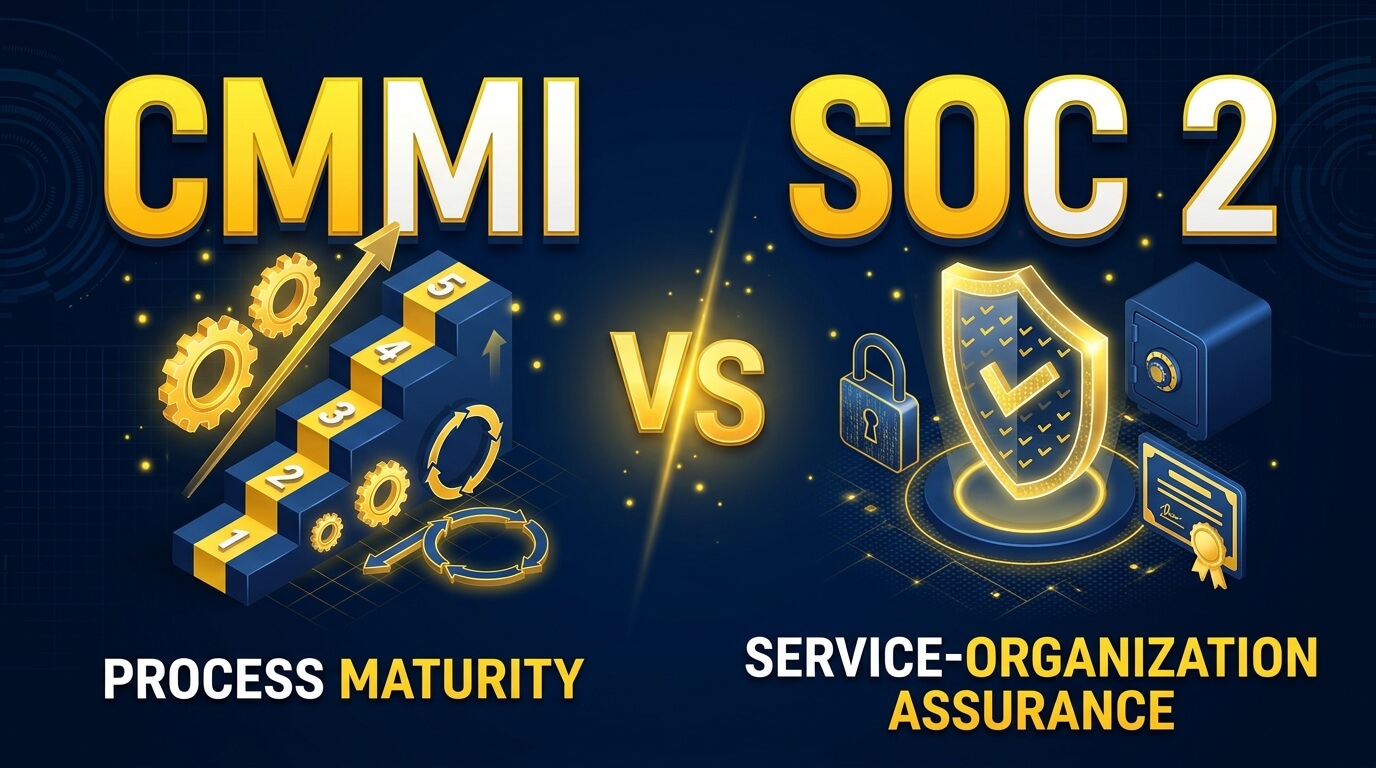
Understanding CMMI vs SOC 2 is important because both approaches can strengthen organizational credibility, but they serve fundamentally different purposes. CMMI focuses on organizational capability, process maturity, and continuous performance improvement. SOC 2 focuses on providing independent assurance regarding controls relevant to the security, availability, processing integrity, confidentiality, and privacy of a service organization's systems.
Although some operational practices and supporting evidence may overlap, achieving a CMMI maturity level does not establish SOC 2 compliance, and obtaining a SOC 2 report does not demonstrate CMMI maturity. Organizations must understand these differences before selecting an assessment, planning an assurance programme, or responding to customer requirements.
This guide examines CMMI vs SOC 2 through a practical comparison, explains where their requirements may overlap, identifies evidence that can be reused, and provides decision criteria for organizations considering one or both approaches.
1. What Is CMMI?
Capability Maturity Model Integration (CMMI) is a performance improvement model designed to help organizations establish, manage, measure, and improve their operational processes. It provides structured practices that organizations can adopt to improve their ability to deliver products and services consistently.
CMMI is particularly relevant to software development companies, IT service providers, engineering organizations, technology businesses, and other organizations seeking predictable operational performance. It helps organizations identify process weaknesses, standardize activities, manage risks, improve quality, and establish measurable performance objectives.
The CMMI maturity framework includes five maturity levels:
- Maturity Level 1 – Initial: Processes are generally unpredictable and reactive, with inconsistent execution and performance.
- Maturity Level 2 – Managed: Projects and activities are planned, performed, measured, and controlled.
- Maturity Level 3 – Defined: Organization-wide standards and documented processes guide operational activities and project execution.
- Maturity Level 4 – Quantitatively Managed: Organizations use quantitative techniques and performance measurements to manage process variation.
- Maturity Level 5 – Optimizing: Organizations focus on continuous improvement, innovation, and optimizing established processes.
Organizations can undergo CMMI appraisals to evaluate how their implemented processes align with applicable model practices. Depending on the appraisal scope and requirements, organizations may achieve a recognized maturity level or capability level.
Importantly, CMMI uses the terminology of appraisal and maturity-level achievement rather than conventional management system certification. A CMMI appraisal evaluates organizational processes against the applicable model and appraisal requirements.
For organizations seeking structured operational improvement, CMMI provides a framework for strengthening process discipline, organizational capability, and business performance.
2. What Is SOC 2?
System and Organization Controls 2 (SOC 2) is an assurance reporting framework developed by the American Institute of Certified Public Accountants (AICPA). It is designed for service organizations that need to demonstrate how their systems and controls address relevant customer and stakeholder requirements concerning information security and service reliability.
SOC 2 examinations evaluate controls against the applicable AICPA Trust Services Criteria (TSC). These criteria address five categories:
- Security: Protection of systems and information against unauthorized access, disclosure, and other security threats.
- Availability: Whether systems and services are available for operation and use in accordance with relevant commitments.
- Processing Integrity: Whether system processing is complete, valid, accurate, timely, and authorized.
- Confidentiality: Protection of information designated as confidential from unauthorized access or disclosure.
- Privacy: Appropriate collection, use, retention, disclosure, and disposal of personal information in accordance with applicable privacy commitments and criteria.
Security is the common category applicable to SOC 2 examinations. Organizations select additional Trust Services Categories based on their services, commitments, system characteristics, and relevant risks.
SOC 2 reports generally fall into two main types:
- SOC 2 Type I: Evaluates the suitability of the design of controls at a specified point in time.
- SOC 2 Type II: Evaluates the suitability of control design and operating effectiveness over a specified examination period.
An independent licensed CPA firm conducts the SOC 2 examination and issues the relevant report. The report provides intended users with information about the service organization's system, management's assertion, and the auditor's opinion and findings.
SOC 2 is particularly relevant to SaaS companies, cloud service providers, data processing organizations, managed IT service providers, and technology businesses handling customer information or delivering critical digital services.
3. CMMI vs SOC 2: Side-by-Side Comparison
The most important distinction between CMMI and SOC 2 is their primary objective. CMMI evaluates organizational capability and process maturity, while SOC 2 provides independent assurance about specified controls within a service organization's system.
The following table highlights their key differences:
| Comparison Area |
CMMI |
SOC 2 |
| Primary Purpose | Improve organizational process maturity and performance. | Provide independent assurance regarding specified service-organization controls. |
| Main Focus | Process management, capability, quality, and continuous improvement. | Security, availability, processing integrity, confidentiality, and privacy. |
| Framework Owner | CMMI Institute / ISACA. | AICPA. |
| Assessment Approach | Formal appraisal against applicable CMMI model and appraisal requirements. | Independent CPA examination against applicable Trust Services Criteria. |
| Typical Outcome | Maturity-level or capability-level appraisal result. | SOC 2 Type I or Type II examination report. |
| Maturity Levels | Five maturity levels, from Initial to Optimizing. | No equivalent five-level maturity structure. |
| Security Coverage | May address security-related practices depending on the selected model and scope. | Evaluates applicable security controls under the Trust Services Criteria. |
| Process Improvement | A central objective. | Not its primary objective, although examinations can identify control deficiencies. |
| Control Effectiveness | Evaluates process implementation against applicable model practices. | Type II examines operating effectiveness over a defined period. |
| Evidence | Process documentation, implementation evidence, performance measures, and appraisal evidence. | Policies, control descriptions, configurations, logs, samples, and testing evidence. |
| Typical Users | Software developers, engineering organizations, IT providers, and service businesses. | SaaS providers, cloud companies, data processors, and technology service organizations. |
| Customer Assurance | Demonstrates assessed process capability and maturity within the stated scope. | Provides an independent report about specified controls and examination results. |
This comparison demonstrates that CMMI and SOC 2 address different organizational objectives. Selecting between them should depend on customer expectations, operational risks, service commitments, and the outcomes the organization needs to demonstrate.
4. Where Do CMMI and SOC 2 Overlap?
Although CMMI and SOC 2 are not equivalent, organizations may identify overlapping operational activities and supporting evidence when implementing both approaches. This overlap can help reduce duplicated documentation and improve the efficiency of compliance and performance management programmes.
The extent of reuse depends on the selected CMMI model, SOC 2 system boundary, applicable Trust Services Categories, organizational responsibilities, and the specific requirements being evaluated.
4.1 Risk Management
Both approaches can involve identifying organizational risks and establishing appropriate responses. CMMI supports structured risk management as part of organizational performance and process execution. SOC 2 uses risk-related considerations to evaluate whether relevant controls address risks that could affect service commitments and system requirements.
A documented risk register, risk ownership records, and mitigation plans may provide reusable evidence. However, a CMMI risk management process does not automatically demonstrate that every applicable SOC 2 control is suitably designed and operating effectively.
4.2 Change Management
Organizations implementing CMMI may establish structured processes for reviewing, approving, documenting, and monitoring changes. SOC 2 examinations may also evaluate change management controls relevant to system security, availability, and processing integrity.
Change requests, approval records, testing results, deployment logs, and rollback documentation may be reused as supporting evidence. Nevertheless, SOC 2 testing may require additional evidence demonstrating that the controls operated consistently throughout the examination period.
4.3 Incident Management
Both approaches can benefit from documented incident management procedures. Organizations may establish incident identification, escalation, investigation, resolution, and corrective action processes.
However, SOC 2 may require additional evidence related to security incidents, notification obligations, access to incident records, and the effectiveness of relevant response controls. General process documentation alone may not be sufficient.
4.4 Performance Monitoring and Continuous Improvement
CMMI places significant emphasis on performance measurement, process evaluation, and continuous improvement. SOC 2 also considers whether controls are appropriately designed and operating effectively to meet relevant system requirements and service commitments.
Monitoring reports, corrective action records, service performance data, and management review documentation may support both programmes when they are relevant to the defined scope. The evidence must still satisfy the distinct evaluation requirements of each framework.
5. Evidence Mapping: What Can Be Reused and What Cannot?
One of the most practical considerations when implementing CMMI and SOC 2 together is determining which existing organizational evidence can support both assessments.
Evidence reuse does not mean that one framework automatically satisfies another. It means that an existing document, record, or operational activity may provide relevant supporting information when it meets the specific requirements and testing expectations of both assessments.
| Evidence or Control Area |
Potential CMMI Application |
Potential SOC 2 Application |
Reuse Assessment |
| Risk Register | Risk identification and management. | Risk assessment supporting relevant controls. | Partially reusable. |
| Change Management Records | Controlled process implementation. | Change authorization, testing, and implementation controls. | Potentially reusable with additional testing evidence. |
| Incident Records | Problem resolution and process improvement. | Security incident identification and response. | Partially reusable. |
| Performance Metrics | Process measurement and performance management. | Monitoring relevant service commitments and controls. | Partially reusable. |
| Access Control Records | May support relevant process and security practices, depending on model scope. | Logical access and authorization controls. | Partially reusable; SOC-specific testing needed. |
| Employee Training Records | Organizational competency and process implementation. | Security awareness and role-related training. | Partially reusable. |
| Backup and Recovery Testing | May support service continuity and operational processes, depending on model scope. | Availability and recovery-related controls. | Partially reusable. |
| SOC 2 Control Testing Results | May provide supporting operational information. | Directly relevant to the SOC 2 examination. | Not a substitute for CMMI appraisal evidence. |
| CMMI Appraisal Results | Demonstrates the applicable appraisal outcome. | May provide organizational context but does not establish SOC 2 control effectiveness. | Not a substitute for SOC 2 examination evidence. |
The distinction between equivalent evidence and partially reusable evidence is essential. An access review document, for example, may be relevant to both process implementation and security controls. However, SOC 2 may require specific evidence of authorization, periodic review, timely access removal, and operating effectiveness over the examination period.
Organizations should therefore establish an evidence-mapping matrix that identifies the source document, applicable requirement, control owner, testing method, evidence period, and any additional evidence needed.
6. What CMMI Does Not Prove About SOC 2
A common misunderstanding is that achieving a higher CMMI maturity level automatically demonstrates that an organization has strong information security controls or meets SOC 2 requirements. This assumption is incorrect.
CMMI evaluates organizational processes against the applicable model. Even when an organization demonstrates mature processes, this does not independently establish that its security controls satisfy the AICPA Trust Services Criteria.
For example, an organization with a CMMI Maturity Level 5 appraisal may demonstrate sophisticated performance measurement and continuous process optimization. However, this result does not prove that:
- All privileged user accounts are appropriately authorized and periodically reviewed.
- Multi-factor authentication is implemented wherever required by the applicable control design.
- Security incidents are identified, investigated, and managed in accordance with defined requirements.
- Customer information is protected through appropriate encryption and access restrictions.
- Backup and recovery controls operate effectively throughout the relevant period.
- Vendor risks and third-party service dependencies are appropriately managed.
- The organization's system meets every applicable SOC 2 Trust Services Criterion.
These matters require appropriate control design, implementation, documentation, and independent examination under SOC 2. A CMMI appraisal result cannot replace that examination.
7. What SOC 2 Does Not Prove About CMMI
The reverse is equally important. A successful SOC 2 examination does not establish that an organization has achieved a particular CMMI maturity level.
A SOC 2 Type II report can provide assurance that relevant controls were suitably designed and operated effectively during the specified examination period, subject to the report's scope, criteria, opinion, exceptions, and other findings.
However, this does not necessarily demonstrate that the organization:
- Has standardized processes across all projects and departments.
- Uses organization-wide process assets and defined procedures.
- Measures process performance through quantitative techniques.
- Manages organizational process variation using statistical methods.
- Has established the continuous optimization practices associated with CMMI Maturity Level 5.
- Has undergone a formal CMMI appraisal or achieved a recognized maturity level.
SOC 2 is primarily concerned with assurance over relevant controls, not an organization's overall process maturity journey. Consequently, organizations that need to demonstrate process capability must consider the appropriate CMMI model and appraisal scope separately.
8. Practical Scenarios: When Should Organizations Choose CMMI or SOC 2?
The right approach depends on the organization's industry, service delivery model, customer expectations, and business objectives. The following scenarios illustrate how different organizations can make practical decisions.
Scenario 1: Software Development Company Seeking Process Excellence
A software development company experiences inconsistent project delivery, recurring defects, weak estimation practices, and difficulties maintaining standardized development processes across multiple teams.
Recommended approach: CMMI.
CMMI can help this organization establish repeatable development practices, improve project planning, strengthen quality management, and introduce measurable performance objectives. A suitable CMMI model and appraisal scope can support the company's long-term process improvement objectives.
SOC 2 may become relevant separately if the company also operates customer-facing systems or processes sensitive customer information and needs to demonstrate control assurance.
Scenario 2: SaaS Provider Seeking Enterprise Customer Trust
A SaaS company provides cloud-based applications to financial institutions and enterprise customers. During procurement, customers request independent assurance about security, system availability, data protection, and access management.
Recommended approach: SOC 2.
SOC 2 is directly relevant because the company needs to provide assurance about controls within its defined service system. A SOC 2 Type I examination may be an initial step, while a Type II examination may be appropriate when customers require evidence of operating effectiveness over a period.
Scenario 3: IT Service Provider Targeting International Contracts
An IT service provider wants to improve operational consistency while also meeting the assurance requirements of international clients. Its customers evaluate project delivery performance, security practices, service reliability, and internal controls.
Recommended approach: Both CMMI and SOC 2, where commercially justified.
CMMI can strengthen the organization's process maturity and delivery capability, while SOC 2 can provide independent assurance over relevant service controls. A coordinated implementation can help reduce duplicated documentation and make better use of common operational evidence.
Scenario 4: Managed Service Provider Handling Sensitive Information
A managed service provider operates customer infrastructure, manages privileged access, supports critical systems, and handles confidential business information. Customers require assurance that relevant security and availability controls are properly implemented.
Recommended approach: SOC 2, supported by appropriate process improvement initiatives.
SOC 2 can directly address the customer's need for independent assurance. CMMI may provide additional value if the organization also needs to improve its service management, delivery processes, and organizational performance.
9. CMMI vs SOC 2: Side-by-Side Decision Guide
Before investing in either approach, organizations should identify the primary business outcome they want to achieve. The following decision table provides a practical selection guide.
| Business Requirement |
Preferred Approach |
Reason |
| Improve software development processes. | CMMI | Focuses on process capability and performance improvement. |
| Demonstrate security controls to enterprise customers. | SOC 2 | Provides independent assurance over relevant controls. |
| Establish standardized organizational processes. | CMMI | Supports organization-wide process definition and implementation. |
| Provide evidence of control operation over time. | SOC 2 Type II | Examines operating effectiveness during a defined period. |
| Improve quantitative process management. | CMMI | Maturity Levels 4 and 5 emphasize quantitative management and optimization. |
| Address customer privacy and confidentiality requirements. | SOC 2 | Relevant Trust Services Categories address these matters. |
| Improve processes and provide external control assurance. | Both | Addresses complementary business and assurance objectives. |
| Meet a contract specifically requiring a CMMI appraisal. | CMMI | The specified appraisal outcome must be addressed directly. |
| Meet a contract specifically requiring a SOC 2 report. | SOC 2 | The requested independent examination report must be obtained. |
Organizations should also consider contractual language carefully. A customer may request a specific CMMI maturity level, a SOC 2 Type II report, or both. One deliverable should not be assumed to satisfy the other unless the customer explicitly agrees to an alternative.
10. Can Organizations Implement CMMI and SOC 2 Together?
Yes. Organizations can implement CMMI and SOC 2 together when they have a business reason to improve internal process maturity while demonstrating external assurance over service-related controls.
However, an integrated implementation requires careful planning. Organizations should avoid treating the two approaches as a single combined certification or appraisal programme.
A practical integrated approach can include the following activities:
- Define organizational objectives: Identify whether the primary priorities are process improvement, customer assurance, contractual requirements, or a combination of these objectives.
- Establish separate scopes: Identify the organizational units, projects, services, systems, and processes relevant to each approach.
- Develop an evidence inventory: Document existing policies, procedures, records, control descriptions, performance measures, and operational evidence.
- Map overlapping requirements: Identify where one document or operational activity can support both approaches without assuming equivalence.
- Address framework-specific gaps: Implement additional security, privacy, service availability, process management, or performance requirements where necessary.
- Assign control and process owners: Establish accountability for implementation, monitoring, evidence collection, and corrective actions.
- Plan independent evaluations: Arrange the appropriate CMMI appraisal and SOC 2 examination through the relevant qualified and authorized professionals.
An integrated approach can improve operational efficiency, but each framework must retain its own evaluation criteria, assessment boundaries, and required outcomes.
11. Common Mistakes When Comparing CMMI and SOC 2
Organizations can waste time and resources when they misunderstand the relationship between process maturity and independent control assurance. The following mistakes should be avoided:
- Assuming CMMI maturity means SOC 2 compliance: CMMI appraisal results do not replace a SOC 2 examination.
- Assuming SOC 2 proves process maturity: A SOC 2 report does not establish a CMMI maturity level.
- Using identical evidence without validation: Documents may be relevant to both approaches but must meet their individual requirements.
- Ignoring system boundaries: SOC 2 applies to the defined system and services included in the examination, not automatically every organizational activity.
- Ignoring model and appraisal scope: A CMMI result applies within its stated organizational and model scope, not necessarily every department or business unit.
- Choosing based only on marketing value: Framework selection should be driven by actual customer requirements, operational risks, and business objectives.
- Confusing SOC 2 Type I and Type II: These reports address different examination objectives and should be selected according to customer expectations and assurance needs.
12. CMMI vs SOC 2: Understanding the Non-Equivalence
The distinction between CMMI and SOC 2 must remain clear throughout implementation, customer communication, and external reporting.
CMMI is a process maturity and performance improvement model, whereas SOC 2 is an independent assurance reporting engagement concerning specified controls within a service organization's system.
Neither approach automatically satisfies, replaces, or establishes achievement under the other. A CMMI Maturity Level 3 or Level 5 appraisal does not demonstrate that an organization has obtained a SOC 2 report. Similarly, a SOC 2 Type II report does not establish that an organization has achieved any CMMI maturity level.
There may be opportunities to reuse supporting documents, operational records, risk assessments, and control activities. However, evidence reuse must be validated against the requirements of each approach. Some evidence may be directly relevant to both, while other evidence may only partially support a second assessment and require additional testing or documentation.
Organizations should therefore maintain separate assessment objectives and reporting expectations while coordinating their implementation activities wherever practical.
13. How B-ADVANCY Supports Organizations with CMMI and Multi-Framework Planning
Organizations seeking stronger operational performance and improved customer confidence may need a structured approach to CMMI adoption, process improvement, and multi-framework coordination. Understanding how different frameworks interact is an important part of developing an effective compliance and assurance strategy.
B-ADVANCY Certification UK Limited supports organizations through management system certification, audits, inspections, consulting, calibration and testing, and professional training. Its professional services and CMMI-related support can help organizations understand applicable requirements, evaluate process improvement opportunities, and plan their approach to organizational capability development.
For organizations considering CMMI alongside SOC 2, a structured multi-framework discussion can help identify:
- The appropriate CMMI model, domain, organizational scope, and appraisal objectives.
- The SOC 2 system boundary and applicable Trust Services Categories.
- Existing organizational processes and controls that may support both approaches.
- Evidence that is directly reusable versus evidence that is only partially reusable.
- Additional control implementation, documentation, and testing requirements.
- The appropriate appraisal and independent examination arrangements.
Importantly, CMMI appraisal activities and SOC 2 examinations have different professional and authorization requirements. Organizations should engage appropriately qualified CMMI appraisal professionals and an independent licensed CPA firm for the relevant SOC 2 examination. A consulting or coordination engagement should not be presented as a substitute for either independent evaluation.
14. Frequently Asked Questions (FAQs)
1. What is the main difference between CMMI and SOC 2?
CMMI focuses on organizational process maturity, capability, and performance improvement. SOC 2 provides independent assurance regarding specified controls relevant to the security, availability, processing integrity, confidentiality, and privacy of a service organization's system.
2. Is CMMI equivalent to SOC 2?
No. CMMI and SOC 2 are not equivalent. CMMI evaluates organizational processes against an applicable maturity or capability model, whereas SOC 2 examines controls against the applicable AICPA Trust Services Criteria. Neither replaces the other.
3. Does CMMI Level 5 mean an organization is SOC 2 compliant?
No. CMMI Level 5 demonstrates an applicable appraisal achievement associated with optimized processes and continuous improvement. It does not establish that security, availability, confidentiality, processing integrity, or privacy controls satisfy SOC 2 requirements.
4. Can an organization implement CMMI and SOC 2 together?
Yes. Organizations can pursue both to improve process maturity and demonstrate independent assurance over relevant service controls. A coordinated implementation can help reduce duplicated work through validated evidence mapping, but each approach retains its separate evaluation requirements.
5. Which is better for software development companies: CMMI or SOC 2?
CMMI is particularly useful when the primary objective is improving software development processes, project management, quality, and organizational performance. SOC 2 is more relevant when the company needs to provide assurance about the controls protecting customer-facing systems and information. Some companies benefit from both.
6. Can CMMI documentation be reused for SOC 2?
Some CMMI documentation, including risk registers, change management records, incident procedures, and performance reports, may support SOC 2 evidence requirements. However, the documentation must be evaluated against the applicable Trust Services Criteria, system boundaries, control descriptions, and examination evidence requirements.
7. Does SOC 2 have maturity levels like CMMI?
No. SOC 2 does not use CMMI's five-level maturity structure. SOC 2 Type I and Type II describe different examination approaches, not organizational maturity levels.
8. Is SOC 2 Type II better than CMMI Level 5?
These outcomes cannot be ranked directly because they measure different things. SOC 2 Type II addresses control design and operating effectiveness over a specified period, while CMMI Level 5 represents an applicable organizational process maturity achievement. The appropriate choice depends on the organization's business objectives and customer requirements.
9. Do customers require both CMMI and SOC 2?
Some enterprise customers, procurement programmes, and technology contracts may request both. However, requirements vary by industry, service type, customer risk expectations, and contractual obligations. Organizations should verify the exact deliverables and applicable scope before starting either programme.
10. How should organizations start a CMMI and SOC 2 programme?
Organizations should begin by reviewing customer requirements, identifying business objectives, defining organizational and system boundaries, assessing existing processes and controls, and preparing a gap analysis. A multi-framework scoping and controls-mapping exercise can identify reusable evidence and separate requirements that need additional implementation or testing.
Conclusion
The comparison of CMMI vs SOC 2 highlights two complementary but fundamentally different approaches to organizational excellence and customer assurance. CMMI helps organizations strengthen process maturity, improve delivery performance, establish consistent practices, and develop a culture of continuous improvement. SOC 2 provides independent assurance regarding specified controls within a service organization's system.
For organizations focused on improving internal operations, CMMI can provide a structured path toward stronger process capability. For service providers seeking to demonstrate control assurance to enterprise customers, SOC 2 may be more directly relevant. Organizations with both objectives can pursue the two approaches together through coordinated planning and carefully validated evidence mapping.
The most effective strategy is not necessarily choosing one framework over the other. It is understanding the requirements of each, identifying where evidence can legitimately be reused, addressing framework-specific gaps, and ensuring that each assessment delivers its intended outcome.
B-ADVANCY encourages organizations to evaluate their operational objectives, customer expectations, and assurance requirements before selecting a framework or planning a multi-framework implementation.
Contact B-ADVANCY:
📞 WhatsApp: Chat on WhatsApp 📧 Email:info@b-advancy.com


 Contact For Services
 Explore Training Calendar