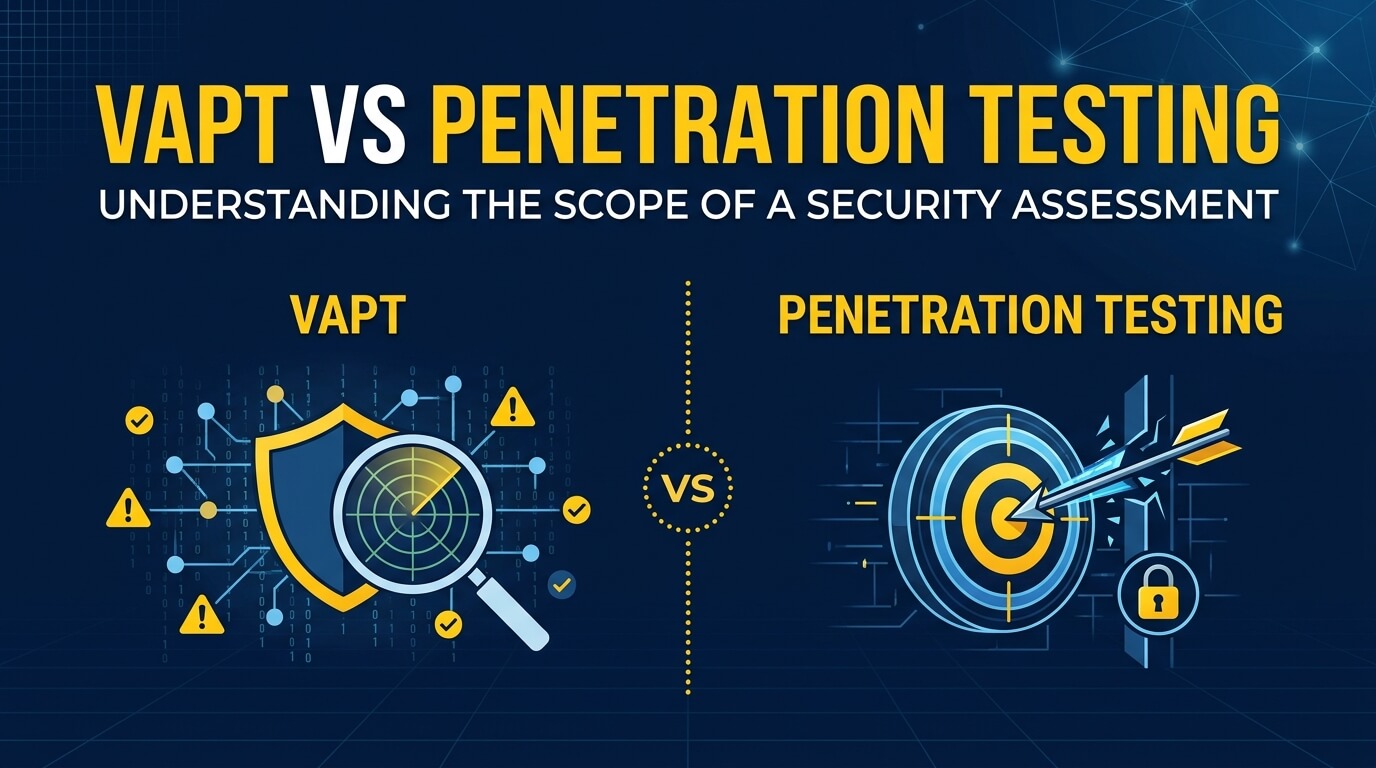
The term VAPT commonly refers to a combined approach that includes vulnerability assessment and penetration testing. A vulnerability assessment identifies and evaluates potential weaknesses, while penetration testing attempts to validate whether selected weaknesses can be exploited under an authorized testing scope. However, terminology and service packages vary between providers, so organizations should confirm exactly which activities, systems, and deliverables are included before commissioning a security assessment.
What Is VAPT?
Vulnerability Assessment and Penetration Testing (VAPT) is a security assessment approach that combines the identification of vulnerabilities with controlled testing of selected security weaknesses. Its purpose is to help organizations understand their exposure to cyber threats, evaluate the effectiveness of security controls, and determine which issues require corrective action.
A VAPT engagement may cover network infrastructure, servers, websites, web applications, APIs, cloud environments, wireless networks, mobile applications, or other agreed technology assets. The precise scope depends on the organization's requirements, risk profile, technical environment, and assessment objectives.
A typical VAPT engagement may include the following activities:
- Identifying in-scope systems, applications, and network assets.
- Scanning for known vulnerabilities, outdated software, insecure configurations, and exposed services.
- Reviewing and validating potential findings to reduce false positives.
- Performing controlled penetration tests against selected systems and vulnerabilities.
- Assessing the potential business impact of confirmed weaknesses.
- Providing a report with findings, severity ratings, evidence, and remediation recommendations.
- Conducting retesting or remediation verification when included in the agreed engagement.
Not every VAPT service includes every activity listed above. Some providers offer vulnerability scanning and penetration testing as separate services, while others package them together. Organizations should review the statement of work rather than relying on the VAPT label alone.
What Is Penetration Testing?
Penetration testing, often called a pen test, is an authorized security exercise in which qualified testers attempt to exploit weaknesses in systems, applications, or infrastructure within a defined scope. The goal is to determine whether identified vulnerabilities or weaknesses in security controls could be used to compromise confidentiality, integrity, or availability.
Unlike a vulnerability scan that primarily identifies potential weaknesses, penetration testing examines how selected weaknesses behave under controlled exploitation attempts. Depending on the authorization and scope, testers may investigate whether an attacker could gain unauthorized access, access sensitive data, bypass security controls, or move from one compromised component to another.
Penetration testing is not simply about finding the largest possible number of vulnerabilities. It evaluates practical attack paths and the effectiveness of defenses while avoiding unnecessary disruption or unauthorized access to data and systems.
Common Types of Penetration Testing
- Network penetration testing: Evaluates network services, exposed ports, access controls, and infrastructure weaknesses.
- Web application penetration testing: Examines application logic, authentication, authorization, session management, input handling, and other web security controls.
- API penetration testing: Evaluates API authentication, access permissions, data exposure, rate limiting, and business logic weaknesses.
- Mobile application penetration testing: Assesses mobile application behavior, local data storage, communication security, authentication, and interactions with backend services.
- Cloud penetration testing: Examines in-scope cloud configurations, identities, permissions, workloads, and exposure paths, subject to provider policies and authorization.
- Internal penetration testing: Simulates an attacker or compromised device operating within an internal network or other trusted environment.
- External penetration testing: Evaluates systems reachable from outside the organization's network, such as public-facing applications, gateways, and internet-accessible services.
The testing approach may be black-box, grey-box, or white-box. Black-box testing provides limited internal information, grey-box testing supplies partial information or access, and white-box testing gives testers more detailed knowledge of the environment. The most appropriate approach depends on the assessment objectives and the risks the organization wants to evaluate.
VAPT vs Penetration Testing: Key Differences
The main difference is that VAPT commonly describes a broader engagement combining vulnerability assessment and penetration testing, whereas penetration testing specifically focuses on controlled attempts to exploit weaknesses. Because service providers sometimes use these terms interchangeably, organizations should compare the actual scope and methods rather than the service name alone.
| Comparison Area |
VAPT |
Penetration Testing |
| Primary scope |
Commonly combines vulnerability assessment and penetration testing. |
Focuses on controlled attempts to exploit weaknesses within an agreed scope. |
| Main objective |
Identify vulnerabilities and evaluate selected weaknesses through testing. |
Determine whether and how selected weaknesses can be exploited. |
| Typical methods |
May include automated scanning, manual validation, configuration checks, and exploitation attempts. |
Uses manual and automated techniques to validate attack paths and security weaknesses. |
| Findings |
Potential and confirmed vulnerabilities, risk ratings, and remediation guidance. |
Evidence of exploitable weaknesses, attack paths, and potential business impact. |
| Coverage |
Can cover a broad range of assets, depending on the engagement. |
May focus on a particular application, network, platform, or attack scenario. |
| Typical use |
Understanding weaknesses across an environment and validating selected risks. |
Testing the practical exploitability and impact of security weaknesses. |
These distinctions are general rather than universal. A narrowly scoped VAPT engagement may cover less than a comprehensive penetration test, while a broad penetration testing program may include extensive vulnerability discovery. The proposal should specify asset coverage, testing depth, methodology, exclusions, and deliverables.
Vulnerability Assessment vs Penetration Testing
Vulnerability assessment and penetration testing serve different but complementary purposes. A vulnerability assessment identifies and prioritizes weaknesses, while penetration testing explores whether selected weaknesses can be exploited and what the resulting impact might be.
Vulnerability Assessment
A vulnerability assessment often uses automated scanners, software inventories, configuration reviews, and manual checks to identify known weaknesses. Findings may include missing security patches, outdated software, insecure settings, exposed services, weak encryption configurations, or known software vulnerabilities.
The results typically require validation because automated tools can produce false positives or overlook contextual factors. A vulnerability assessment can be useful for broad coverage, recurring security checks, and establishing a prioritized remediation backlog. By itself, however, it may not demonstrate that a vulnerability can be exploited in the organization's specific environment.
Penetration Testing
Penetration testing uses a defined testing methodology to investigate and validate potential attack paths. Testers may attempt controlled exploitation, examine access boundaries, and assess whether one weakness can be combined with another to create a more serious security issue.
For example, a vulnerability assessment may identify an application component with a known weakness. A penetration test may then determine whether the weakness is exploitable in the tested environment and whether it could allow unauthorized access to sensitive functionality. Any exploitation must remain within the approved scope and safety limits.
What Should a VAPT Engagement Include?
A well-defined VAPT engagement should specify the systems to be assessed, the testing methods, the limits of authorized activity, and the expected reporting outputs. A clear scope helps prevent misunderstandings and supports meaningful security improvements.
1. Scope Definition and Authorization
Document the in-scope IP addresses, domains, applications, APIs, cloud accounts, environments, and other relevant assets. Confirm ownership or authorization to test, identify excluded systems, agree testing windows, and define emergency contacts. Third-party systems should not be tested without appropriate permission.
2. Discovery and Vulnerability Identification
The assessment team identifies relevant assets, services, software versions, entry points, and potential weaknesses. Depending on the agreed scope, this stage may combine automated scanning, manual checks, configuration analysis, and review of available technical documentation.
3. Validation and Controlled Exploitation
Potential findings are validated where possible, and authorized penetration testing is performed against selected weaknesses. The team should follow agreed safety restrictions, protect sensitive information, avoid unnecessary service disruption, and stop or escalate activity if unexpected risks arise.
4. Risk Analysis and Reporting
The report should explain each finding, the affected asset, supporting evidence, severity, potential impact, and recommended corrective action. Risk ratings should reflect both technical characteristics and relevant business context. Organizations should be able to distinguish confirmed vulnerabilities from unverified observations or informational findings.
5. Remediation and Retesting
After the organization addresses the findings, retesting can verify whether the identified weaknesses have been resolved. The retest scope should be agreed in advance and should establish whether the original issue remains, has been remediated, or requires further work. Retesting does not guarantee that the entire environment is free from vulnerabilities.
How to Choose Between VAPT and Penetration Testing
The right approach depends on the organization's objectives, current security maturity, available budget, technical environment, and external requirements. Organizations should define the security question they need answered before selecting an assessment service.
- Choose a vulnerability assessment when: You need broad visibility into known weaknesses, regular scanning, configuration checks, or a prioritized remediation list.
- Choose penetration testing when: You need to evaluate whether selected weaknesses can be exploited, examine attack paths, or test the effectiveness of specific security controls.
- Consider a combined VAPT engagement when: You need vulnerability discovery alongside controlled exploitation and risk validation within the same engagement.
- Consider specialist testing when: Your risks involve areas such as complex APIs, mobile applications, cloud identity configurations, business logic, or segmented internal networks that require dedicated expertise.
For example, an organization launching a new customer portal may commission web application penetration testing to evaluate authentication, access control, and sensitive data exposure. A company with a large network may need recurring vulnerability assessments to identify weaknesses across many systems, supplemented by targeted penetration tests for higher-risk assets. A combined approach can be appropriate when both broad discovery and exploit validation are required.
Factors to Consider Before Commissioning a Security Assessment
Before selecting a provider, organizations should examine more than the price or the number of systems covered. The quality and usefulness of the assessment depend on the provider's technical capability, methodology, scope, and reporting practices.
- Defined objectives: Confirm the business and security questions the assessment must address.
- Asset coverage: Verify that the relevant applications, networks, environments, and interfaces are included.
- Testing methodology: Ask which recognized methodologies and technical practices will guide the work.
- Tester competence: Evaluate relevant experience, qualifications, and expertise in the technologies being tested.
- Safety and authorization: Agree rules of engagement, permitted testing techniques, data handling, and escalation procedures.
- Report quality: Ensure the report includes clear evidence, practical recommendations, and understandable risk prioritization.
- Retesting arrangements: Clarify whether verification of remediation is included or priced separately.
- Compliance context: Identify the contractual, regulatory, or customer requirements the assessment is intended to support.
Security assessments should be planned as part of an ongoing cybersecurity program. A single assessment provides a view of the tested systems at a particular time; new vulnerabilities, configuration changes, software releases, and evolving attack methods can introduce additional risks later.
How VAPT Supports Cybersecurity and Compliance
VAPT and penetration testing can support an organization's broader cybersecurity and compliance objectives by providing evidence about technical weaknesses and the effectiveness of selected controls. They may contribute to risk treatment, security improvement planning, supplier assurance, and internal governance when their scope is aligned with the organization's requirements.
Relevant frameworks and standards include ISO/IEC 27001 for information security management, the OWASP Web Security Testing Guide for web application testing, and the NIST Technical Guide to Information Security Testing and Assessment (SP 800-115). These resources serve different purposes: ISO/IEC 27001 establishes requirements for an information security management system, while technical testing guides provide approaches for evaluating security controls and identifying weaknesses.
Completing a VAPT engagement does not automatically establish compliance with ISO/IEC 27001 or any other regulatory framework. Organizations must address the applicable requirements, maintain appropriate governance and controls, and retain evidence relevant to their compliance obligations.
How B-ADVANCY Can Support Cybersecurity Readiness
Effective cybersecurity requires a clear understanding of technical risks, documented processes, suitable controls, and employees who understand their responsibilities. Organizations should assess their security needs in relation to their business operations, information assets, applicable standards, and customer or regulatory expectations.
B-ADVANCY is a global certification and sustainable business assurance provider offering management system certification, audits and inspections, consulting, calibration and testing, and professional training. Organizations seeking to strengthen IT process compliance and information security governance can explore the relevant IT Process Compliance services and discuss their specific requirements with the team.
When selecting a VAPT or penetration testing provider, organizations should confirm the provider's technical qualifications, authorization procedures, testing scope, reporting deliverables, and ability to meet the required objectives. Any consulting, certification, training, or assurance service should be clearly distinguished from the technical penetration testing activity itself.
Frequently Asked Questions About VAPT and Penetration Testing
1. Is VAPT the same as penetration testing?
Not necessarily. VAPT commonly combines vulnerability assessment and penetration testing, while penetration testing focuses on controlled attempts to exploit weaknesses. Providers sometimes use the terms interchangeably, so the actual scope and deliverables should always be confirmed.
2. Does VAPT include vulnerability scanning?
A combined VAPT engagement commonly includes vulnerability scanning or other vulnerability identification activities, but the exact scope varies. Confirm whether automated scanning, manual validation, configuration review, penetration testing, and retesting are included.
3. How often should an organization conduct VAPT?
Frequency depends on risk exposure, system changes, business requirements, and applicable obligations. Organizations often schedule assessments periodically and after significant changes, such as launching a new application, modifying critical infrastructure, or introducing major changes to cloud environments. Additional testing may be necessary when new threats or vulnerabilities emerge.
4. Can automated tools replace penetration testers?
Automated tools can identify many known vulnerabilities and misconfigurations, but they may miss complex business logic flaws, chained attack paths, and weaknesses requiring contextual judgment. Skilled testers can investigate these issues and validate selected attack scenarios. Automated and manual techniques are often most useful when combined appropriately.
5. What should a VAPT report contain?
A useful report typically includes the assessment scope, methodology, limitations, findings, affected assets, supporting evidence, severity ratings, potential impact, and remediation recommendations. It should also distinguish confirmed findings from unverified observations and explain whether retesting is included.
6. Does a successful penetration test mean a system is completely secure?
No. A penetration test evaluates the systems and attack scenarios included in its defined scope during a particular period. It cannot prove that every vulnerability has been identified or that future attacks will be prevented. Ongoing monitoring, patch management, secure development, access controls, and periodic reassessment remain important.
7. Is VAPT required for ISO/IEC 27001 compliance?
The need for vulnerability assessments and penetration testing depends on the organization's risk treatment decisions, applicable controls, contractual requirements, and other relevant obligations. VAPT may provide useful evidence for information security risk management, but completing it alone does not establish ISO/IEC 27001 conformity or certification.
Conclusion
Understanding VAPT vs penetration testing helps organizations choose a security assessment that matches their risks and objectives. Vulnerability assessment supports broad identification and prioritization of weaknesses, while penetration testing evaluates whether selected weaknesses can be exploited through controlled, authorized testing. A combined VAPT engagement can provide both perspectives when its scope includes the necessary activities.
The most effective approach begins with clear objectives, defined authorization, suitable testing methods, and actionable reporting. Organizations should use the findings to prioritize remediation, strengthen security controls, and verify corrective actions where appropriate. Regular reassessment and ongoing cybersecurity management are essential because a security assessment represents a point-in-time view rather than a guarantee of complete protection.
📞 WhatsApp:Chat on WhatsApp📧 Email:info@b-advancy.com


 Contact For Services
 Explore Training Calendar