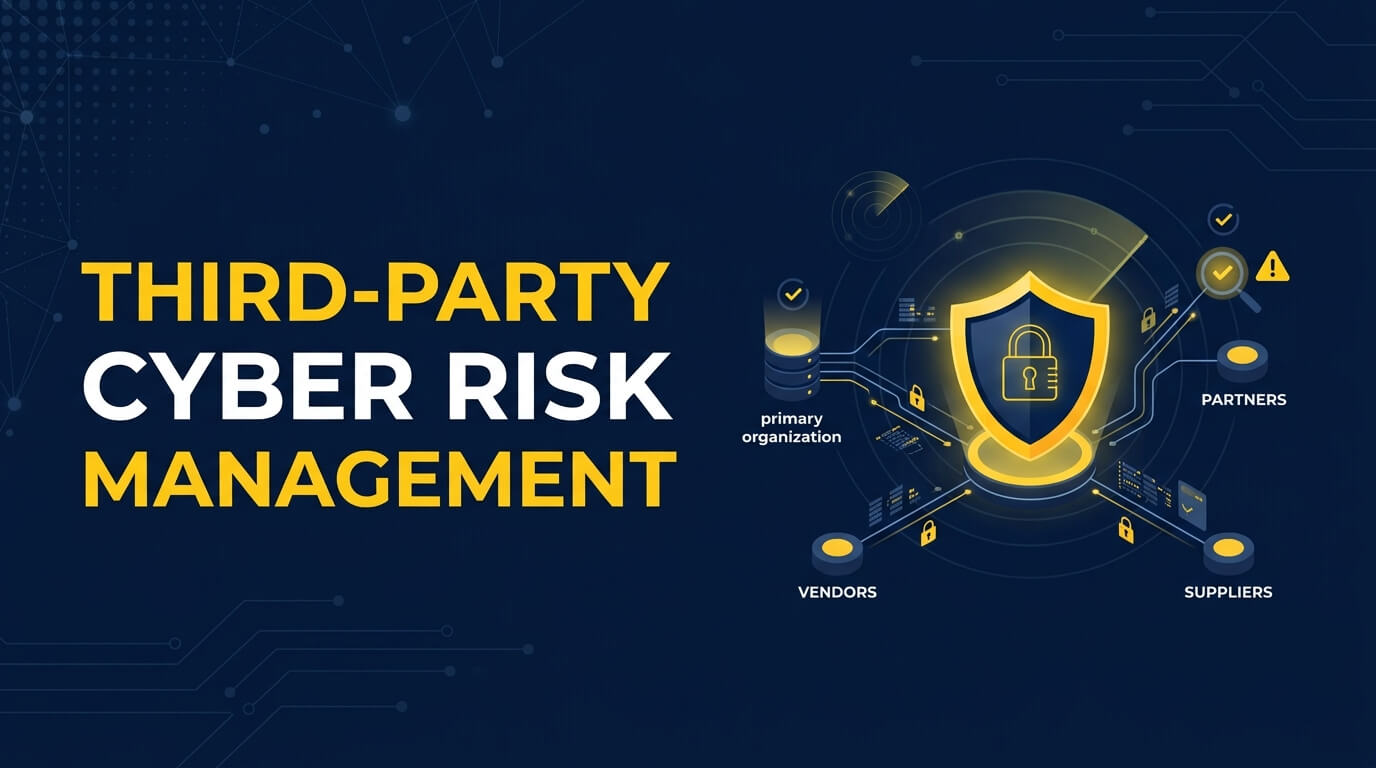
Third-party cyber risk management has become an essential part of organizational cybersecurity as businesses increasingly depend on external vendors, suppliers, contractors, cloud service providers, and technology partners. These relationships can improve efficiency, support innovation, and reduce operational costs, but they may also introduce cybersecurity vulnerabilities. A security weakness within a third-party organization can expose sensitive information, interrupt business operations, and create financial, legal, and reputational consequences for its customers and partners. An effective third-party cyber risk management program helps organizations identify, assess, monitor, and reduce these risks throughout the entire supplier relationship lifecycle.
Organizations need to understand that cybersecurity responsibilities do not end at their own network boundaries. Vendors may access business systems, process customer information, store confidential records, or provide critical digital services. Without appropriate oversight, these connections can create opportunities for data breaches, ransomware incidents, unauthorized access, and supply chain attacks. By establishing structured risk assessment procedures, clear contractual requirements, continuous monitoring, and incident response arrangements, businesses can improve resilience and strengthen trust across their supply chains.
What Is Third-Party Cyber Risk Management?
Third-party cyber risk management is the process of identifying, evaluating, treating, and monitoring cybersecurity risks associated with external organizations that have access to a company's systems, data, infrastructure, or business processes. These third parties may include software providers, IT service companies, cloud platforms, managed service providers, payment processors, consultants, logistics partners, and outsourced business process providers.
The objective is not simply to confirm that a vendor has security policies in place. Organizations must determine whether the vendor's controls are appropriate for the services it provides, the information it handles, and the potential impact of a security incident. This requires evaluating risks before entering into a business relationship and continuing that assessment throughout the relationship.
Third-party cyber risk management is closely related to third-party risk management (TPRM) and supply chain risk management. While TPRM can cover financial, legal, operational, and reputational risks, third-party cyber risk management focuses specifically on threats to information security, technology environments, data privacy, and digital service continuity.
Why Is Third-Party Cyber Risk Management Important?
A business may have strong internal security controls and still face serious exposure through an external provider. Vendors can become an entry point for attackers when their systems, credentials, software, or processes are inadequately protected. Effective third-party cyber risk management helps organizations address these interconnected risks before they develop into major incidents.
1. Protecting Sensitive and Confidential Information
External providers may process personal information, employee records, customer databases, financial details, intellectual property, or commercially sensitive documents. If a vendor experiences a data breach, the consequences may extend to the organizations that entrusted it with their information. Assessing access controls, encryption practices, data retention, secure deletion, and incident notification procedures helps reduce this exposure.
2. Reducing Supply Chain Cybersecurity Threats
Cybercriminals may target smaller suppliers or technology partners to reach larger organizations. Software dependencies, remote access tools, shared accounts, and managed services can create pathways between different business environments. Evaluating supplier security and controlling these connections can help organizations reduce the likelihood and potential impact of supply chain attacks.
3. Maintaining Business Continuity
An external provider's ransomware incident, service outage, or system compromise can interrupt business activities even when the affected organization has not experienced a direct attack. Evaluating vendor resilience, backup arrangements, disaster recovery capabilities, and alternative service options helps organizations prepare for disruptions and maintain essential operations.
4. Supporting Regulatory and Contractual Compliance
Organizations may have legal, regulatory, contractual, or customer-specific obligations concerning data protection and cybersecurity. Depending on the sector and jurisdiction, these obligations may involve privacy requirements, financial sector controls, payment security, or contractual security commitments. A documented third-party risk management process helps organizations demonstrate oversight, maintain relevant records, and identify gaps that require corrective action. However, vendor assessments alone do not guarantee compliance with every applicable requirement.
5. Protecting Customer Trust and Business Reputation
Customers and business partners expect organizations to manage the information and services entrusted to them responsibly. A security incident involving an external supplier can damage confidence, delay projects, and increase scrutiny from customers or regulators. Consistent supplier security practices help organizations demonstrate accountability and build stronger business relationships.
Common Third-Party Cyber Risks
Understanding common threat scenarios is an important step in designing an effective third-party cyber risk management framework. The level of exposure varies according to the vendor's access, the sensitivity of the information involved, the importance of the service, and the security measures in place.
- Data breaches: Unauthorized access to personal, financial, confidential, or proprietary information held by a supplier.
- Weak identity and access management: Excessive permissions, shared credentials, inadequate authentication, or accounts that remain active after access is no longer required.
- Ransomware and malware: Malicious software affecting a vendor's environment and potentially disrupting connected services or exposing shared information.
- Software supply chain vulnerabilities: Security weaknesses in third-party applications, libraries, updates, or other technology components.
- Inadequate patch management: Delays in addressing known vulnerabilities in systems used to deliver services.
- Cloud security misconfigurations: Incorrect permissions, exposed storage, weak administrative controls, or insufficient separation of customer environments.
- Subcontractor exposure: Security risks introduced by fourth parties or other subcontractors that participate in delivering a service.
- Insufficient incident response: Delayed detection, unclear reporting responsibilities, or inadequate coordination when a vendor experiences a security event.
- Business continuity failures: Inadequate backup, recovery, or contingency arrangements that prevent a supplier from maintaining critical services.
These risks cannot all be addressed through the same controls. Organizations should prioritize them according to their likelihood, potential impact, and relationship to business-critical operations.
Key Steps to Build an Effective Third-Party Cyber Risk Management Program
Step 1: Identify and Maintain an Inventory of Third Parties
Organizations need a reliable inventory of external parties that can access their information, systems, facilities, or business services. This inventory should include technology vendors, cloud service providers, consultants, outsourced service providers, software suppliers, and other relevant partners.
For each supplier, record the services provided, business owner, types of data accessed, system connections, access privileges, subcontracting arrangements, contract dates, and criticality to business operations. Procurement, IT, cybersecurity, legal, privacy, and business teams should coordinate to identify suppliers that may otherwise be overlooked.
Step 2: Classify Vendors According to Risk
Not every vendor requires the same level of scrutiny. A supplier with no access to sensitive information may present a different risk profile from a cloud provider hosting business-critical systems. A risk-based classification model helps allocate resources to the relationships that could cause the greatest harm if compromised.
Common classification factors include:
- Sensitivity and volume of information handled.
- Level of access to internal networks, applications, and administrative systems.
- Importance of the service to critical business operations.
- Potential financial, operational, legal, and reputational impact of an incident.
- Use of subcontractors and dependencies on other technology providers.
- Applicable regulatory obligations and customer security requirements.
Organizations can then define assessment frequencies, evidence requirements, approval levels, and monitoring activities for each risk category.
Step 3: Conduct Cybersecurity Due Diligence
Before onboarding a new supplier, organizations should evaluate its security policies, technical controls, governance arrangements, and ability to manage incidents. The assessment should be proportionate to the supplier's risk level and the nature of the service being provided.
Useful assessment activities may include security questionnaires, review of relevant policies, independent audit reports, applicable certifications, penetration testing summaries where appropriate, vulnerability management evidence, and business continuity documentation. Organizations should verify the scope, validity, and relevance of any assurance evidence rather than treating a certificate or questionnaire as proof that every risk has been eliminated.
For higher-risk vendors, additional technical reviews or independent assessments may be necessary. Any identified gaps should be documented, evaluated, and addressed through remediation plans, contractual safeguards, alternative controls, or a decision not to proceed with the relationship.
Step 4: Establish Clear Contractual Security Requirements
Contracts should clearly define the cybersecurity responsibilities of both parties. Security expectations should be agreed upon before sensitive information is shared or system access is granted. Where appropriate, contractual provisions should address:
- Data protection, confidentiality, and permitted use of information.
- Authentication, access control, and secure remote access requirements.
- Security incident reporting timelines and cooperation obligations.
- Vulnerability management, security updates, and relevant testing requirements.
- Subcontractor approval, disclosure, and security oversight requirements.
- Audit rights or other appropriate assurance mechanisms.
- Data retention, return, secure deletion, and termination procedures.
- Business continuity, disaster recovery, and service restoration expectations.
Requirements should be tailored to the relevant service, applicable law, and the organization's risk appetite. Legal, procurement, cybersecurity, and business stakeholders should work together to ensure that obligations are practical, measurable, and enforceable.
Step 5: Apply Strong Access Controls and Data Protection Measures
Third-party access should be limited to what is necessary for the agreed service. Organizations should use least-privilege principles, multifactor authentication where appropriate, individual accounts, secure remote access, and periodic access reviews. Administrative privileges should receive additional oversight, and access should be promptly revoked when a contract ends or a user's responsibilities change.
Data protection measures should also reflect the sensitivity of the information involved. Depending on the use case, these measures may include encryption, data minimization, secure transfer methods, logical separation of environments, retention limits, and documented deletion procedures. Monitoring access and maintaining appropriate logs can help organizations identify unusual activity and investigate potential incidents.
Step 6: Continuously Monitor Third-Party Security
A vendor's security posture can change after onboarding. New vulnerabilities, ownership changes, acquisitions, subcontracting arrangements, service modifications, or security incidents may introduce additional risks. Organizations should therefore establish ongoing monitoring rather than relying entirely on a one-time assessment.
Monitoring activities may include periodic reassessments, review of assurance reports, tracking of remediation actions, relevant threat intelligence, contract compliance checks, and reassessment following significant changes. The frequency and depth of monitoring should depend on vendor criticality and the organization's exposure.
External security ratings and automated monitoring tools can provide useful signals, but they should not replace direct engagement, contextual risk analysis, or verification of critical controls. Organizations should establish clear escalation procedures for significant findings.
Step 7: Prepare for Third-Party Security Incidents
Organizations should agree in advance how they will respond if a supplier experiences a cyber incident that may affect shared systems, data, or services. A coordinated response plan should identify responsible contacts, escalation routes, communication methods, evidence preservation procedures, and decision-making authority.
Incident response arrangements should address how to contain affected connections, suspend compromised accounts, assess potential data exposure, restore essential services, and meet applicable notification obligations. Organizations should periodically test their response procedures through exercises or simulations involving relevant suppliers where feasible.
Step 8: Manage Vendor Offboarding and Contract Termination
Cyber risk management must continue until the supplier relationship has been properly closed. When a contract ends, organizations should revoke system access, disable accounts, recover company-owned assets, retrieve or securely delete information as agreed, and confirm the completion of required handover activities.
Offboarding procedures should also address outstanding vulnerabilities, unresolved incidents, retained data, subcontractor access, and continuity arrangements for replacement services. Documenting these activities helps reduce the risk of unauthorized access or information exposure after the business relationship ends.
Standards and Frameworks That Support Third-Party Cyber Risk Management
Recognized cybersecurity standards and frameworks can help organizations establish consistent processes for supplier assessment, risk treatment, information security governance, and continual improvement. The most appropriate approach depends on the organization's industry, regulatory environment, business model, and existing management systems.
ISO/IEC 27001 Information Security Management
ISO/IEC 27001 provides requirements for establishing, implementing, maintaining, and continually improving an information security management system (ISMS). Its risk-based approach can help organizations manage information security risks involving suppliers and external service providers. Organizations can use the standard to structure responsibilities, risk assessments, control selection, monitoring, and improvement activities. Certification, where obtained, applies to the defined scope of the ISMS and should not be interpreted as a guarantee against cyber incidents.
Learn more about B-ADVANCY's services through the IT Process Compliance service page.
ISO/IEC 27002 Information Security Controls
ISO/IEC 27002 provides guidance on information security controls that organizations can consider when designing and improving their security practices. It can support decisions involving access management, supplier relationships, incident management, data protection, and operational security. Organizations should select and implement controls according to their risk assessments and applicable requirements.
NIST Cybersecurity Framework
The NIST Cybersecurity Framework offers an outcome-based approach to managing cybersecurity risk. Its Govern, Identify, Protect, Detect, Respond, and Recover functions can help organizations integrate supplier risks into wider cybersecurity governance and operational processes. It can also support communication between leadership, security teams, procurement, and business owners.
ISO 22301 Business Continuity Management
ISO 22301 provides requirements for a business continuity management system. It can help organizations identify critical activities, assess disruption impacts, and prepare for incidents affecting external suppliers. Integrating business continuity planning with third-party cyber risk management can strengthen preparedness for outages, ransomware events, and other disruptions to essential services.
These standards and frameworks serve different purposes and can be used together where appropriate. Organizations should review the relevant editions, implementation guidance, and sector-specific requirements before deciding how to apply them.
Challenges in Managing Third-Party Cyber Risks
Even organizations with established security programs can face difficulties when assessing and monitoring external providers. Understanding these challenges helps businesses design a program that is practical, scalable, and aligned with business priorities.
- Limited visibility: Organizations may not have sufficient information about a supplier's internal security practices or subcontractor relationships.
- Large supplier networks: Managing hundreds or thousands of external relationships can make consistent assessment and follow-up difficult.
- Inconsistent assessment methods: Different business units may use different questionnaires, approval processes, and security requirements.
- Resource constraints: Smaller organizations may lack dedicated personnel, specialized tools, or sufficient budgets for extensive assessments.
- Changing threat conditions: New vulnerabilities and emerging attack techniques can alter vendor risk between scheduled reviews.
- Supplier resistance: Vendors may be reluctant or unable to provide detailed security evidence, particularly when they serve many customers.
- Overreliance on questionnaires: Self-reported answers may not provide enough evidence to validate the effectiveness of critical controls.
Organizations can address these challenges by prioritizing high-risk relationships, standardizing assessment criteria, assigning clear ownership, using automation where appropriate, and focusing on evidence that is proportionate to the potential impact. Smaller suppliers can be supported through clear requirements, remediation guidance, and realistic improvement timelines where risk permits.
How to Measure Third-Party Cyber Risk Management Performance
Organizations should measure whether their third-party cyber risk management program is identifying meaningful risks, addressing weaknesses, and improving oversight. Performance indicators should support decisions and highlight areas requiring action rather than simply measuring administrative activity.
Useful key performance indicators (KPIs) and key risk indicators (KRIs) may include:
- Percentage of active third parties recorded in the supplier inventory.
- Percentage of critical suppliers with current cybersecurity assessments.
- Number of high-risk findings that remain unresolved.
- Average time taken to remediate significant supplier security weaknesses.
- Percentage of critical suppliers with reviewed incident response and continuity arrangements.
- Number of supplier-related incidents and recurring control failures.
- Percentage of vendor relationships with defined security requirements and accountable business owners.
- Percentage of completed offboarding processes with access revocation and data handling verified.
Metrics should be interpreted in context. For example, a rise in reported incidents may reflect better detection and reporting rather than a decline in security. Leadership should review trends alongside risk exposure, remediation progress, assessment quality, and the business impact of identified issues.
The Role of Leadership and Organizational Governance
Successful third-party cyber risk management requires cooperation across the organization. Cybersecurity teams provide technical expertise, procurement manages supplier selection, legal teams review contractual obligations, privacy teams address personal data concerns, and business owners evaluate service criticality. Senior management should establish the risk appetite, approve appropriate policies, allocate resources, and ensure that significant supplier risks receive timely attention.
Clear governance also helps prevent suppliers from being onboarded without adequate review or continuing to provide services despite unresolved critical risks. Documented approval paths, exception management, periodic reporting, and defined accountability make the program more consistent and auditable.
Organizations should also provide appropriate cybersecurity awareness to employees who select vendors, manage external accounts, share information, or approve invoices and service changes. Employees who understand supplier-related threats can help identify suspicious requests, unauthorized access, and unexpected changes in vendor behavior.
How B-ADVANCY Can Support Cybersecurity and IT Process Improvement
Organizations seeking to strengthen third-party cyber risk management can benefit from structured governance, documented processes, risk-based controls, and continual improvement. B-ADVANCY supports organizations through certification-related services, audits and inspections, consulting, and professional training across relevant management system and business assurance areas.
The appropriate approach depends on each organization's needs, current controls, industry, and applicable requirements. Organizations should clearly distinguish between consulting or readiness support, independent audit activities, and formal certification or appraisal processes. Any formal certification should be pursued within the relevant standard, scope, and applicable conformity assessment arrangements.
Frequently Asked Questions About Third-Party Cyber Risk Management
What is the main objective of third-party cyber risk management?
Its main objective is to identify, assess, reduce, and monitor cybersecurity risks introduced by external suppliers and service providers. This helps organizations protect sensitive information, maintain essential services, and make informed decisions about vendor relationships.
How often should organizations assess third-party cybersecurity risks?
Assessment frequency should depend on supplier criticality, data sensitivity, system access, contractual obligations, and changes in the threat environment. High-risk suppliers may require more frequent reviews, while significant incidents or changes in services should trigger reassessment when appropriate.
Is ISO/IEC 27001 useful for third-party cyber risk management?
Yes. ISO/IEC 27001 provides a risk-based information security management system approach that can help organizations establish governance, assess information security risks, select appropriate controls, and monitor supplier-related risks within the defined ISMS scope.
What is the difference between third-party and fourth-party cyber risk?
Third-party cyber risk concerns an organization's direct suppliers and service providers. Fourth-party risk generally concerns the suppliers or subcontractors used by those direct providers. Organizations should consider relevant downstream dependencies when they could affect the security or continuity of important services.
Can small businesses implement third-party cyber risk management?
Yes. Small businesses can begin with a basic supplier inventory, risk classification, essential security questions, clear contract requirements, access reviews, and incident response contacts. They can then expand their processes according to business growth, supplier exposure, and available resources.
Does vendor certification eliminate third-party cyber risk?
No. A relevant certification or independent assurance report can provide useful evidence about defined controls and scope, but it does not eliminate all cyber risks. Organizations should verify the scope and validity of the evidence and maintain risk-based oversight throughout the supplier relationship.
Conclusion
Third-party cyber risk management is a critical component of modern cybersecurity and supply chain resilience. As organizations rely on increasingly connected networks of suppliers, software providers, cloud platforms, and outsourced services, security risks can extend well beyond their internal systems. A structured approach helps organizations identify critical vendors, assess security controls, establish contractual requirements, monitor changes, prepare for incidents, and manage supplier offboarding responsibly.
By integrating third-party cyber risk management with information security governance, recognized frameworks, and continual improvement, organizations can make better risk decisions and strengthen operational resilience. Effective implementation requires collaboration between leadership, cybersecurity, procurement, legal, privacy, and business teams, supported by clear responsibilities and measurable performance indicators.

 Contact For Services
 Explore Training Calendar