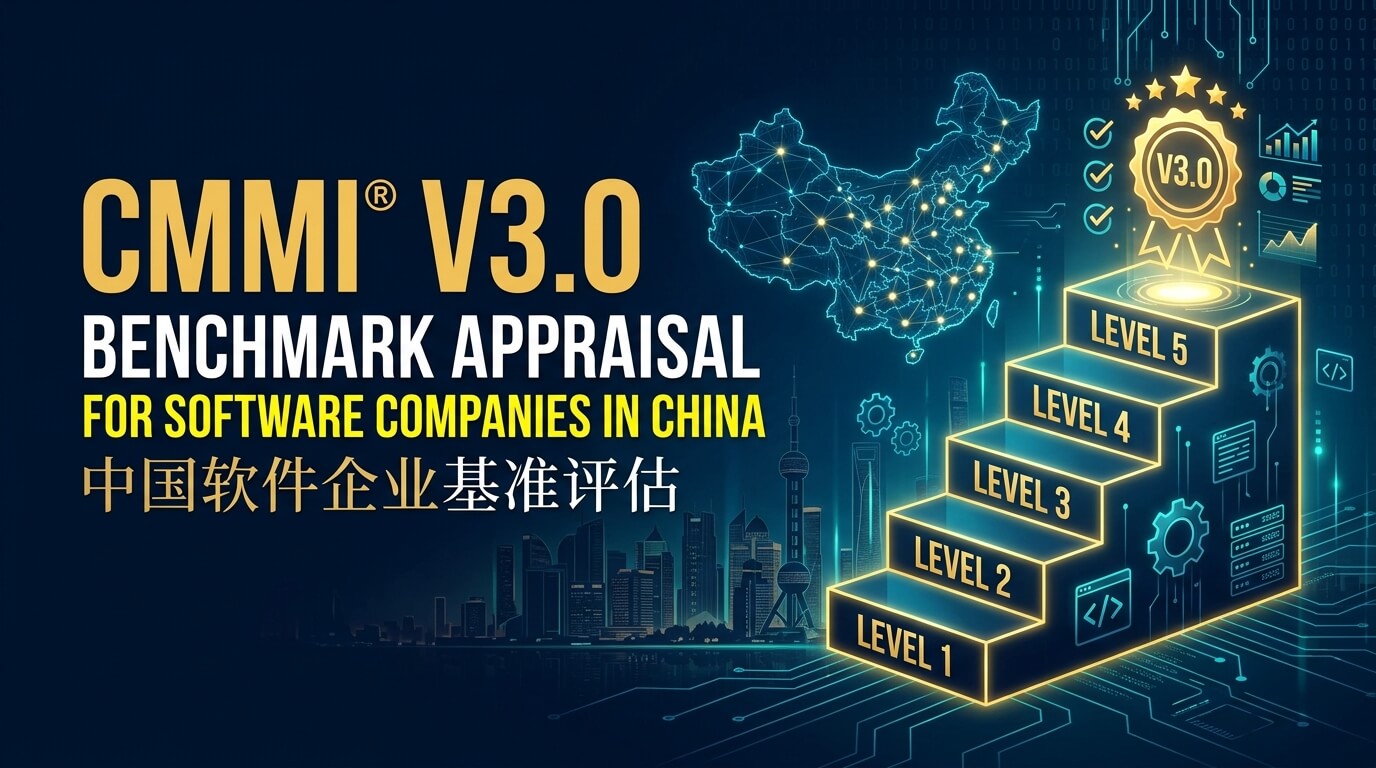
China's software development industry serves a broad range of markets, including enterprise software, financial technology, cloud computing, artificial intelligence, telecommunications, e-commerce, manufacturing technology, and international IT outsourcing. As software companies expand their services and work with customers across different markets, maintaining consistent development practices, reliable delivery schedules, and measurable quality becomes increasingly important.
The Capability Maturity Model Integration (CMMI) framework provides organizations with a structured approach to improving processes, managing risks, and strengthening business performance. For software development companies, a CMMI V3.0 Benchmark Appraisal offers a formal way to evaluate organizational practices against the applicable CMMI model and identify opportunities for improvement.
A Benchmark Appraisal can help organizations understand their process strengths and weaknesses, evaluate how consistently established practices are implemented, and demonstrate an applicable appraisal outcome to customers and business partners. However, achieving a particular maturity level requires the organization to satisfy the relevant appraisal requirements; it cannot be guaranteed through documentation or consulting alone.
This guide explains how CMMI V3.0 Benchmark Appraisal applies to software development companies in China, which process areas deserve attention, how to prepare for an appraisal, and how organizations can use the results to support long-term business growth.
What Is CMMI V3.0 Benchmark Appraisal?
CMMI V3.0 is a version of the Capability Maturity Model Integration framework designed to help organizations improve capabilities and performance across relevant business and technical activities. Its model content supports structured process improvement and can be applied according to an organization's selected solution, business objectives, and appraisal scope.
A CMMI Benchmark Appraisal is a formal appraisal conducted under the applicable CMMI appraisal method. It evaluates relevant process implementation and supporting evidence against the selected model's requirements and best practices. The appraisal is led by a qualified CMMI Certified Lead Appraiser and follows the applicable rules for appraisal planning, evidence collection, evaluation, and reporting.
Unlike an informal internal review, a Benchmark Appraisal follows a defined method and can result in an applicable maturity-level or capability-level outcome when the organization meets the relevant criteria. Its purpose is not merely to inspect process documents, but to evaluate how organizational practices are implemented and supported by evidence within the defined scope.
For software development companies in China, this provides an opportunity to evaluate development and management practices systematically, address process weaknesses, and establish a stronger foundation for consistent software delivery.
Why CMMI V3.0 Matters for Software Development Companies in China
Software companies must manage increasingly complex development environments. Distributed teams, changing customer requirements, security expectations, technology updates, and demanding delivery schedules can create operational challenges when processes are not consistently implemented.
A structured CMMI adoption initiative helps organizations evaluate these challenges and develop practical improvements aligned with business objectives.
CMMI-related process improvement can be particularly relevant for Chinese companies that:
- Develop enterprise software, commercial applications, and digital business platforms.
- Provide software engineering, IT outsourcing, or application maintenance services.
- Manage multiple development teams, projects, or delivery centers.
- Serve international customers with defined quality and delivery expectations.
- Need more reliable estimation, project monitoring, and risk management practices.
- Want to improve engineering consistency and organizational performance.
- Need to respond to customer procurement requirements that specify an applicable CMMI appraisal outcome.
The objective should be to improve the organization's actual capabilities rather than pursuing a maturity level solely for marketing purposes. Sustainable process improvement can help a company establish practices that remain useful as its projects, customer base, and technology portfolio grow.
Key Process Areas for Software Development Companies
Preparing for a CMMI V3.0 Benchmark Appraisal requires organizations to understand the practices relevant to their selected model and scope. For software development businesses, several process disciplines commonly deserve attention during process improvement and readiness activities.
1. Requirements Development and Management
Unclear requirements can cause rework, delivery delays, budget overruns, and disagreements with customers. Software companies should establish effective practices for gathering, analyzing, documenting, validating, and managing changing requirements.
Requirements should be traceable to relevant design elements, development activities, and verification results where appropriate. Changes should be evaluated and communicated so that teams understand their effects on scope, resources, risks, and delivery commitments.
2. Project Planning and Monitoring
Reliable project management depends on realistic estimates, defined responsibilities, resource planning, milestone tracking, and timely identification of deviations. Companies should maintain project plans that reflect the actual scope and complexity of their software work.
Monitoring activities help project managers compare actual performance with plans, identify emerging issues, and take corrective action. Historical project data can improve estimation and planning accuracy over time.
3. Verification and Validation
Software verification and validation help organizations determine whether products meet specified requirements and intended user needs. Depending on the project, activities may include code reviews, design reviews, functional testing, integration testing, system testing, and user acceptance testing.
Consistent testing procedures, documented results, defect tracking, and appropriate approval mechanisms help organizations identify problems earlier and improve product reliability.
4. Risk Management
Software projects face technical, operational, financial, schedule, security, and supplier-related risks. Organizations should identify relevant risks, evaluate their potential impact, assign ownership, and monitor planned responses.
A consistent risk management process helps teams make informed decisions and reduce the likelihood that foreseeable issues will disrupt project delivery.
5. Configuration and Change Management
Software development requires controlled management of source code, requirements, design documents, test assets, releases, and other configuration items. Weak configuration practices can result in unauthorized changes, inconsistent versions, and difficulties reproducing software defects.
Version control, change approval, baseline management, and release records can help teams maintain traceability and control throughout the software lifecycle.
6. Process Quality Assurance and Measurement
Quality assurance helps determine whether established processes are followed and whether identified deviations are addressed appropriately. Measurement practices help organizations evaluate performance using relevant data rather than relying entirely on subjective judgments.
Useful measures may include defect trends, schedule variance, rework, estimation accuracy, test coverage, and corrective-action completion. The specific indicators should be selected according to business objectives and the applicable CMMI model.
Understanding CMMI Maturity Levels
CMMI maturity levels provide a way to characterize an organization's process capability and performance within the applicable model and appraisal scope. The commonly recognized maturity progression includes five levels, from initial process performance to optimization and continuous improvement.
Maturity Level 1: Initial
At this level, process performance may be unpredictable, and success can depend heavily on individual effort. Software companies may focus on establishing basic project discipline, clarifying responsibilities, and improving visibility into project execution.
Maturity Level 2: Managed
The organization establishes management practices for planning, monitoring, and controlling relevant work. Project activities become more structured, and teams improve their ability to manage commitments, resources, requirements, and risks.
Maturity Level 3: Defined
Processes are defined and managed more consistently across the organization. Teams use established organizational approaches while adapting them appropriately to individual projects and operational needs.
Maturity Level 4: Quantitatively Managed
The organization applies quantitative management practices to selected processes and performance objectives. Data and analysis support greater understanding of performance variation and help teams make more informed decisions.
Maturity Level 5: Optimizing
The organization focuses on continual improvement, innovation, and addressing the causes of performance problems. Improvement initiatives are informed by performance evidence and business objectives.
These descriptions provide a general overview, not a substitute for the official CMMI V3.0 model. The requirements and scope applicable to a particular Benchmark Appraisal should be confirmed against the current model documentation and appraisal method. Organizations should select targets based on business needs and realistic improvement priorities rather than assuming that every company must pursue the highest level.
CMMI V3.0 Benchmark Appraisal Preparation Process
Preparation is an important part of a successful appraisal initiative. Software development companies should plan sufficient time to evaluate their current practices, address weaknesses, and demonstrate implementation through reliable evidence.
Step 1: Define the Business Objectives and Appraisal Scope
Begin by identifying why the organization is pursuing a CMMI appraisal. Objectives may include improving software delivery, addressing customer requirements, standardizing processes across teams, or establishing a measurable improvement roadmap.
Determine the relevant organizational unit, participating projects, selected CMMI model components, and intended appraisal outcome. Scope decisions should reflect the applicable rules and the organization's real operational structure.
Step 2: Conduct a Readiness Assessment and Gap Analysis
Review existing processes, project records, management practices, and evidence against the applicable CMMI model. Identify gaps between expected practices and actual implementation, and prioritize findings according to their significance and business impact.
A readiness assessment can also help management understand resource requirements and determine whether additional process improvement is needed before scheduling the formal Benchmark Appraisal.
Step 3: Standardize Processes and Responsibilities
Develop or improve process descriptions, templates, workflows, and responsibilities where necessary. Ensure that the documented approach reflects actual work practices and allows appropriate tailoring for different projects.
Process owners should understand their responsibilities, and employees should receive practical training on the activities relevant to their roles.
Step 4: Collect and Verify Objective Evidence
Evidence may include project plans, requirements records, review results, risk registers, test reports, configuration records, measurement data, and corrective-action documentation, depending on the applicable practices and scope.
Records should be authentic, traceable, relevant, and consistent with actual activities. Organizations should not create retrospective evidence merely to make a process appear implemented.
Step 5: Address Gaps and Monitor Improvements
Assign owners and deadlines to improvement actions. Track progress, resolve implementation issues, and verify whether corrective measures are effective. Allow enough time for teams to apply revised processes during real project work and generate appropriate evidence.
Step 6: Coordinate the Formal Benchmark Appraisal
Work with a qualified CMMI Certified Lead Appraiser to plan the formal appraisal in accordance with the applicable method and policies. The appraisal team evaluates the relevant implementation evidence and conducts the required activities before reporting the formal outcome.
A readiness assessment supports preparation but does not replace the Benchmark Appraisal or guarantee that the intended maturity or capability level will be achieved.
Benefits of CMMI V3.0 Benchmark Appraisal for Chinese Software Companies
When aligned with practical business objectives, CMMI adoption and formal appraisal activities can provide software development organizations with a structured basis for improving process performance.
- Improved delivery predictability: Better planning, estimation, monitoring, and risk management can support more reliable project execution.
- More consistent engineering practices: Shared processes can reduce unnecessary variation across teams and projects.
- Stronger quality management: Structured verification, validation, and defect management can help identify issues earlier.
- Better decision-making: Relevant performance data can help management identify problems and prioritize improvements.
- Improved customer confidence: A formal appraisal outcome can provide useful information to customers and business partners evaluating process capability.
- Support for supplier evaluations: Organizations may use relevant appraisal information when responding to procurement requirements, subject to customer-specific conditions.
- Scalable organizational processes: Defined and continually improved practices can support growth across projects, teams, and delivery locations.
Benefits vary according to the organization's existing capabilities, implementation quality, selected appraisal scope, and management commitment. A CMMI appraisal should be treated as part of a broader performance improvement strategy rather than a standalone guarantee of business success.
Common Challenges During CMMI Appraisal Preparation
Software development companies may encounter several challenges while preparing for a CMMI V3.0 Benchmark Appraisal. Common issues include inconsistent processes across projects, incomplete records, unclear ownership, limited employee awareness, and insufficient time to implement improvements.
Another challenge occurs when organizations focus on documentation instead of actual process execution. Written procedures cannot establish capability if employees do not follow them or if the organization cannot demonstrate relevant implementation evidence.
Management can address these challenges by defining realistic objectives, assigning process owners, providing role-based training, monitoring corrective actions, and ensuring that improvement activities are integrated into normal project operations.
Organizations should also distinguish between consulting, readiness assessment, and formal appraisal activities. The roles, responsibilities, independence requirements, and applicable conflict-of-interest policies must be respected throughout the appraisal process.
Choosing CMMI Consulting and Appraisal Support in China
Selecting appropriate support can help organizations navigate the technical and operational aspects of CMMI V3.0 adoption. Software companies should evaluate a provider's experience with the relevant model, understanding of software engineering, ability to conduct practical gap analysis, and knowledge of the formal appraisal requirements.
Organizations should clarify the proposed scope, deliverables, schedule, responsibilities, and fees before beginning an engagement. They should also verify the current qualifications and authorization of the Lead Appraiser and confirm that formal appraisal activities will follow the applicable CMMI Institute requirements.
Support may include CMMI awareness training, process documentation improvement, gap analysis, implementation planning, evidence readiness, and coordination of formal appraisal arrangements. The specific services available will depend on the provider's current capabilities and authorization.
B-ADVANCY Certification UK Limited supports organizations through management system consulting, process improvement, professional training, and CMMI-related consulting services. Software development companies in China can discuss their process improvement objectives and appraisal preparation requirements with the B-ADVANCY team.
Conclusion
CMMI V3.0 Benchmark Appraisal can provide software development companies in China with a structured way to evaluate process implementation, identify organizational weaknesses, and establish a roadmap for improved performance. By focusing on requirements management, project planning, verification, risk management, configuration control, and measurement, organizations can strengthen the practices that support reliable software delivery.
Successful preparation requires management commitment, realistic planning, employee participation, reliable evidence, and sustained process implementation. Organizations should select appraisal objectives according to their business needs and ensure that all formal appraisal activities follow the applicable model and method requirements.
For software companies seeking to improve operational consistency, respond to customer expectations, and build stronger process capabilities, a structured CMMI V3.0 improvement initiative can be a valuable step toward sustainable business performance.
Prepare for Your CMMI V3.0 Appraisal with B-ADVANCY
Are you planning a CMMI V3.0 Benchmark Appraisal for your software development organization in China? B-ADVANCY can discuss your process improvement goals, readiness assessment needs, and CMMI-related consulting requirements to help you plan your next steps.
Contact our team to discuss your organization's current processes, intended appraisal scope, and improvement priorities.
📞 WhatsApp:Chat on WhatsApp📧 Email:info@b-advancy.com


 Contact For Services
 Explore Training Calendar