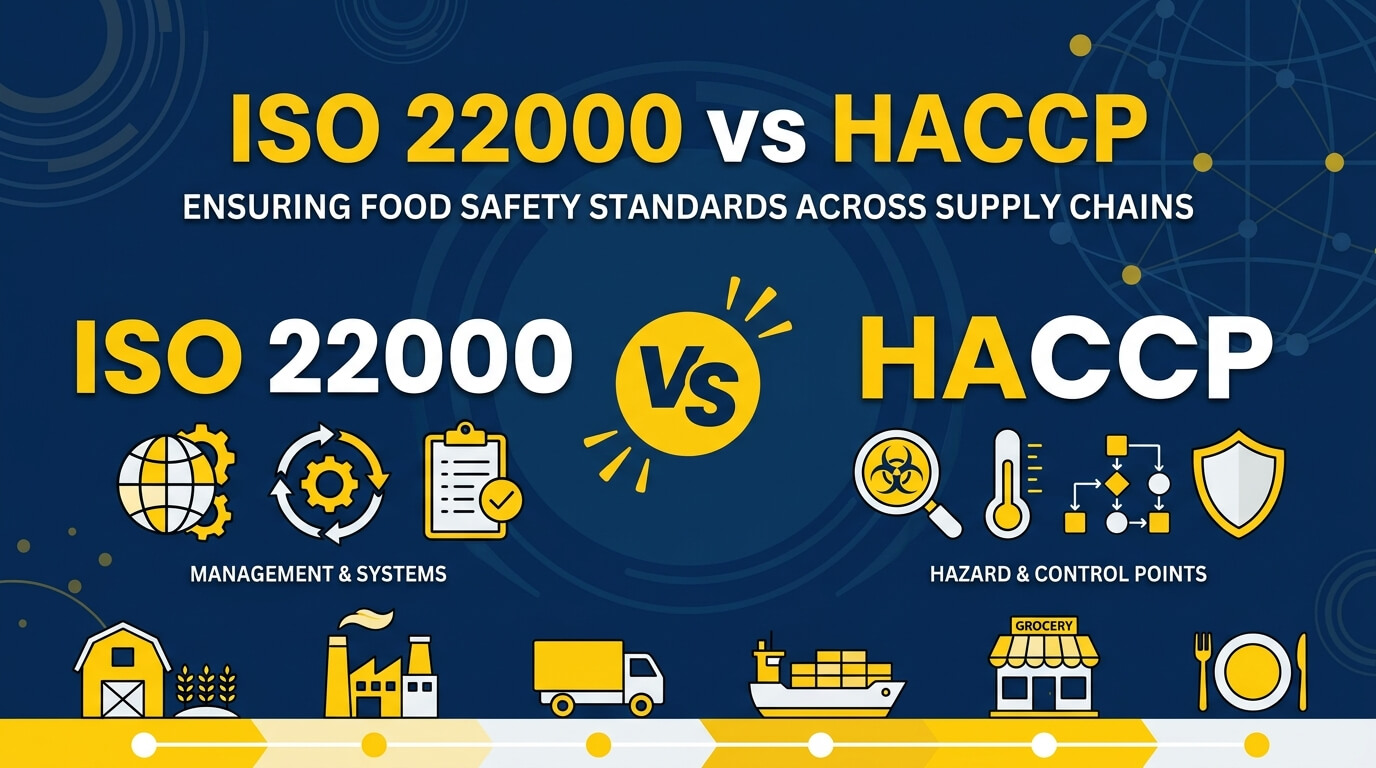
Food safety is a critical responsibility for organizations involved in food production, processing, packaging, storage, transportation, distribution, and retail. A single food safety failure can lead to product recalls, consumer illness, financial losses, regulatory action, and long-term damage to brand reputation. To prevent these risks, businesses use internationally recognized food safety frameworks such as Hazard Analysis and Critical Control Points (HACCP) and ISO 22000. Although both approaches aim to prevent food safety hazards, they differ in scope, structure, and implementation. Understanding ISO 22000 vs. HACCP helps organizations choose an appropriate approach and strengthen food safety controls throughout their supply chains.
HACCP provides a systematic method for identifying, evaluating, and controlling biological, chemical, and physical hazards that could make food unsafe. ISO 22000 establishes requirements for a food safety management system (FSMS), incorporating HACCP principles alongside management-system processes, prerequisite programmes, communication, and continual improvement. Depending on their operations, customers, markets, and legal obligations, organizations may use HACCP, implement ISO 22000, or integrate HACCP principles within an ISO 22000-based management system.
This article explains the differences between ISO 22000 and HACCP, their respective benefits, how they apply across food supply chains, and the practical steps organizations can take to strengthen food safety performance.
What Is HACCP in Food Safety?
Hazard Analysis and Critical Control Points (HACCP) is a preventive food safety approach designed to identify significant hazards and establish controls at appropriate stages of food production and handling. Rather than depending only on finished-product testing, HACCP focuses on preventing hazards from occurring or controlling them before they compromise food safety.
HACCP can be applied in food manufacturing, catering, meat and seafood processing, dairy production, beverage manufacturing, food packaging, and other operations where food safety hazards must be controlled. Its implementation should be supported by appropriate hygiene practices, trained personnel, suitable facilities, and procedures for cleaning, sanitation, pest control, and other basic food safety measures.
The Seven Principles of HACCP
HACCP is based on seven internationally recognized principles used to establish and maintain a hazard control system.
- Conduct a hazard analysis: Identify potential biological, chemical, and physical hazards and evaluate their significance.
- Determine critical control points (CCPs): Identify process steps where control is essential to prevent, eliminate, or reduce a significant food safety hazard to an acceptable level.
- Establish critical limits: Define measurable or otherwise verifiable limits that separate acceptable from unacceptable conditions at each CCP.
- Establish monitoring procedures: Determine how each CCP will be monitored to confirm that it remains under control.
- Establish corrective actions: Define actions to take when monitoring indicates a deviation from an established critical limit.
- Establish verification procedures: Confirm that the HACCP system is implemented correctly and remains effective.
- Establish documentation and records: Maintain appropriate evidence of hazard analysis, monitoring, corrective actions, verification, and other relevant activities.
These principles help organizations establish a structured approach to food safety risk management. However, an effective HACCP system also depends on prerequisite programmes and general hygiene controls that create suitable conditions for producing and handling safe food.
What Is ISO 22000?
ISO 22000 is an international standard specifying requirements for a food safety management system. It is designed for organizations directly or indirectly involved in the food chain, regardless of their size or complexity, provided the requirements are applicable to their activities. The standard combines food safety hazard control with management-system principles, enabling organizations to establish, operate, maintain, and continually improve their food safety processes.
The ISO 22000 framework includes interactive communication, system management, prerequisite programmes, and HACCP principles. This integrated structure helps businesses connect day-to-day food safety controls with leadership responsibilities, risk-based planning, documented information, performance evaluation, and continual improvement.
The standard can be relevant to farms, food manufacturers, ingredient suppliers, packaging producers, transport and storage operators, food retailers, catering companies, and other businesses that influence food safety. Its requirements must be applied according to the organization's role, processes, risks, and operating context.
Key Elements of ISO 22000
- Food safety management system: Establish processes, responsibilities, policies, and controls to manage food safety systematically.
- Leadership and accountability: Define management responsibilities, provide necessary resources, and promote a food safety culture.
- Prerequisite programmes (PRPs): Maintain basic hygiene and operational conditions appropriate to the food chain sector.
- Hazard analysis and control measures: Apply HACCP principles and determine appropriate operational controls.
- Communication throughout the food chain: Exchange relevant food safety information with suppliers, customers, contractors, and appropriate authorities.
- Traceability and emergency preparedness: Establish appropriate arrangements for tracing products and responding to food safety incidents or emergencies.
- Performance evaluation and improvement: Monitor system performance, conduct internal audits and management reviews, address nonconformities, and improve the FSMS.
By integrating these elements, ISO 22000 helps organizations manage food safety as an ongoing business responsibility rather than treating it solely as a production-level activity.
ISO 22000 vs. HACCP: Key Differences
ISO 22000 and HACCP are closely related, but they are not interchangeable. HACCP primarily provides a method for identifying and controlling significant food safety hazards. ISO 22000 incorporates HACCP principles into a broader food safety management system with requirements for leadership, planning, communication, documentation, evaluation, and continual improvement.
Scope and Structure
HACCP focuses on hazard analysis and the control measures needed to prevent food safety hazards from making food unsafe. ISO 22000 addresses these controls within a formal management-system structure. It connects hazard control with organizational responsibilities, operational planning, communication, performance monitoring, and system improvement.
Management Responsibilities
A HACCP plan requires defined responsibilities and appropriate implementation, but HACCP itself is a set of principles rather than a standalone ISO management-system standard. ISO 22000 explicitly addresses leadership, resource management, planning, and management-system performance. This broader framework can help organizations coordinate food safety responsibilities across departments and locations.
Documentation and Continual Improvement
HACCP documentation typically records hazard analysis, CCPs where applicable, critical limits, monitoring, corrective actions, and verification activities. ISO 22000 also requires documented information and management-system processes appropriate to its requirements. These include internal audit, management review, nonconformity management, and continual improvement.
Certification and Recognition
HACCP-based programmes may be required by legislation, customers, industry schemes, or specific market arrangements. The term "HACCP certification" can refer to different programmes and assessment arrangements, so organizations should verify the scheme, scope, and recognition requirements before selecting a provider.
ISO 22000 is a certifiable management-system standard. Organizations may seek certification through an appropriately competent certification body where certification is commercially or contractually beneficial. Certification does not remove the organization's responsibility to comply with applicable food safety laws or ensure that products remain safe in every circumstance.
How ISO 22000 and HACCP Work Together
Rather than treating ISO 22000 and HACCP as competing alternatives, organizations should understand how they complement one another. HACCP principles form a core part of the hazard control approach within ISO 22000, while ISO 22000 provides the wider management system for establishing and maintaining food safety controls.
For example, a dairy processor may use hazard analysis to identify microbiological risks associated with raw milk and processing operations. The organization then determines appropriate control measures, establishes monitoring and corrective actions where required, and maintains relevant records. Under an ISO 22000-based FSMS, these activities are integrated with supplier controls, employee competence, documented procedures, internal audits, management reviews, and continual improvement.
This combination helps organizations connect operational food safety measures with broader governance and accountability. It also supports consistent communication between suppliers, processors, logistics providers, retailers, and other parties whose activities may affect food safety.
Ensuring Food Safety Across the Supply Chain
Food safety risks can arise at any stage between primary production and final consumption. A well-designed food safety system should therefore consider the complete process, including the sourcing of raw materials, handling, processing, packaging, storage, transport, and distribution. ISO 22000 and HACCP-based controls can help organizations identify and manage relevant hazards within their respective responsibilities.
1. Primary Production and Raw Material Sourcing
Food safety management begins with suitable raw materials and controlled sourcing practices. Farms, fisheries, agricultural suppliers, and ingredient producers should address hazards relevant to their activities, including contamination, chemical residues, pests, and unsuitable handling conditions.
Food businesses should establish supplier approval criteria, specifications, incoming inspection procedures, and risk-based verification activities. Supplier records and traceability information can help organizations investigate problems and respond efficiently when a raw material does not meet food safety requirements.
2. Food Processing and Manufacturing
Processing facilities must control hazards associated with equipment, personnel, ingredients, process conditions, and the production environment. Depending on the product and process, controls may include heat treatment, cooling, allergen management, separation of raw and ready-to-eat products, sanitation, and protection against foreign objects.
HACCP helps the organization determine which hazards require specific controls and where critical control points are appropriate. ISO 22000 provides a broader framework for maintaining procedures, competent personnel, operational monitoring, corrective actions, and system verification.
3. Packaging and Labelling
Packaging protects food from contamination and environmental exposure, while labelling provides information necessary for safe handling and consumption. Packaging materials should be suitable for their intended use, and labelling processes should be controlled to reduce errors involving ingredients, allergens, storage instructions, and product identification.
Food manufacturers should establish appropriate inspection, approval, and change-control processes for packaging and labels. Traceability between product batches, packaging materials, and production records can also support efficient investigations and recalls.
4. Storage and Transportation
Food may become unsafe when storage or transport conditions are unsuitable. Temperature abuse, poor sanitation, damaged packaging, cross-contamination, and inadequate pest control can compromise product safety and quality.
Warehouses, refrigerated transport operators, and distribution companies should establish controls suited to the food they handle. These may include temperature monitoring, vehicle hygiene checks, segregation of incompatible goods, equipment maintenance, and documented responses to deviations. Food safety requirements should also be communicated clearly between the parties involved.
5. Retail, Catering, and Final Distribution
Retailers, restaurants, catering businesses, and institutional kitchens must maintain suitable hygiene, storage, preparation, and service practices. Risks can arise from inadequate cooking or cooling, allergen cross-contact, contaminated equipment, improper handling, or poor personal hygiene.
Appropriate food safety procedures, staff training, cleaning schedules, supplier controls, and recordkeeping can help prevent these hazards. The exact requirements depend on the type of operation, the products handled, and applicable local food safety regulations.
Benefits of ISO 22000 for Food Businesses
An effective ISO 22000-based food safety management system can help organizations coordinate preventive controls, improve operational consistency, and demonstrate a systematic approach to food safety. Its value depends on meaningful implementation, management commitment, employee participation, and ongoing evaluation.
- Systematic hazard management: Supports the identification, assessment, and control of relevant food safety hazards.
- Improved operational consistency: Encourages documented processes and defined responsibilities across food handling and production activities.
- Stronger supplier coordination: Supports food safety communication and coordination with relevant supply chain partners.
- Better traceability and incident response: Helps organizations maintain information needed to investigate issues and support product withdrawal or recall activities.
- Customer and market confidence: Can help demonstrate a structured food safety management approach to customers and business partners.
- Continual improvement: Encourages evaluation of performance, investigation of nonconformities, and implementation of corrective actions.
- Support for market requirements: May help organizations meet customer or supply chain expectations where ISO 22000 certification is requested, subject to the relevant requirements.
When Should an Organization Choose HACCP or ISO 22000?
The right approach depends on the organization's operations, regulatory obligations, customer expectations, and food safety objectives. There is no universal answer for every business, and HACCP should not be treated as optional where it is required by applicable law or another binding requirement.
When HACCP May Be an Appropriate Starting Point
A HACCP-based approach may be a practical starting point for an organization that needs to establish or improve systematic hazard analysis and control procedures. It can help a business focus on the specific hazards associated with its products, processes, equipment, and handling practices.
Before selecting a HACCP programme or assessment provider, the organization should confirm the applicable regulatory requirements, customer specifications, scope of assessment, and recognition expected in its target market.
When ISO 22000 May Be More Suitable
ISO 22000 may be suitable for businesses that want a formal food safety management system covering both operational hazard controls and management processes. It can be particularly useful when an organization needs consistent procedures across several departments, facilities, or supply chain activities, or when customers request certification to the standard.
Businesses that already operate a HACCP-based system can build on their existing hazard analysis, monitoring procedures, and records when developing an ISO 22000-based FSMS. A gap assessment can help determine which additional management-system processes and documented information are needed.
Practical Steps to Implement ISO 22000 and HACCP
Effective implementation should reflect the organization's size, food products, operational complexity, and significant food safety risks. The following steps provide a practical implementation roadmap.
Step 1: Define the Scope and Understand Applicable Requirements
Identify the facilities, products, processes, services, and food chain activities covered by the food safety system. Determine applicable legal requirements, customer specifications, relevant codes of practice, and other obligations that affect the business.
Step 2: Establish Prerequisite Programmes
Establish appropriate hygiene and operational conditions before relying on hazard-specific controls. Depending on the operation, these may include cleaning and sanitation, pest management, maintenance, personal hygiene, supplier approval, waste management, and prevention of cross-contamination.
Step 3: Conduct Hazard Analysis
Identify potential hazards at each relevant stage of the process and evaluate their likelihood and severity using an appropriate method. Determine which hazards require control and select suitable measures. Under ISO 22000, organizations must follow its requirements for selecting and categorizing control measures, including operational prerequisite programmes and CCPs where applicable.
Step 4: Establish Monitoring and Corrective Actions
Define monitoring methods, responsibilities, frequencies, and acceptance criteria for relevant controls. Establish clear procedures for responding to deviations, including evaluation of affected products, restoration of control, documentation, and decisions about product disposition.
Step 5: Train Employees and Communicate Requirements
Ensure that employees understand their food safety responsibilities and receive training appropriate to their tasks. Communication should extend to relevant suppliers, contractors, transport operators, and customers whenever their activities or decisions may affect food safety.
Step 6: Maintain Records and Verify the System
Maintain records appropriate to the applicable framework and the organization's risks. Verification activities may include reviewing monitoring records, inspecting operations, checking equipment, evaluating corrective actions, and conducting internal audits. ISO 22000 also requires management-system evaluation and continual improvement processes.
Step 7: Prepare for Assessment or Certification
Where certification is required or commercially beneficial, review the applicable certification scope, scheme rules, documentation, implementation evidence, and readiness for an independent assessment. Address identified nonconformities and confirm that the organization can demonstrate effective implementation within the agreed scope.
Common Food Safety Management Mistakes to Avoid
Even a documented food safety system can be ineffective if it is not properly implemented or reviewed. Organizations should avoid the following common problems:
- Treating HACCP as a paperwork exercise rather than an operational hazard control system.
- Failing to establish and maintain appropriate prerequisite programmes.
- Using generic hazard analysis without considering the actual products, equipment, processes, and operating conditions.
- Failing to investigate monitoring deviations or document appropriate corrective actions.
- Overlooking supplier risks, transport conditions, storage practices, or other activities outside the main production facility.
- Providing insufficient training or failing to communicate responsibilities throughout the organization.
- Assuming that certification alone guarantees food safety without effective daily controls and continual monitoring.
How B-ADVANCY Can Support Food Safety Management
Developing an effective food safety management system requires an understanding of the organization's processes, relevant hazards, legal obligations, customer requirements, and operational capabilities. Businesses may need support with gap assessment, documentation development, staff awareness, implementation planning, and preparation for an independent assessment.
B-ADVANCY provides management-system certification, audit and inspection, consulting, and professional training services. Organizations considering ISO 22000 or a HACCP-based programme should confirm the applicable service scope, assessment arrangements, and recognition requirements before engaging a provider.
To explore relevant management-system and compliance support, visit B-ADVANCY's official website or contact the organization to discuss your food safety objectives and operational needs.
Frequently Asked Questions (FAQs)
1. What is the main difference between ISO 22000 and HACCP?
HACCP is a preventive method for identifying and controlling food safety hazards. ISO 22000 is a food safety management-system standard that incorporates HACCP principles alongside requirements for management, communication, prerequisite programmes, performance evaluation, and continual improvement.
2. Is HACCP included in ISO 22000?
Yes. ISO 22000 incorporates HACCP principles within its food safety hazard control framework. It also includes broader management-system requirements to support the consistent implementation and improvement of food safety controls.
3. Is ISO 22000 better than HACCP?
Neither approach is universally better for every organization. HACCP focuses on hazard analysis and control, while ISO 22000 provides a broader management-system framework. The appropriate choice depends on applicable legal requirements, customer expectations, business objectives, and the complexity of operations.
4. Can a small food business implement ISO 22000?
Yes. ISO 22000 is designed for organizations across the food chain regardless of size or complexity. A small business can implement an FSMS proportionate to its activities and risks while meeting the standard's applicable requirements.
5. Does HACCP certification guarantee food safety?
No. A HACCP assessment or certification can provide evidence that a defined programme has been evaluated against particular criteria, but it cannot guarantee that every food safety risk will be eliminated. Effective implementation, monitoring, verification, corrective action, and compliance with applicable laws remain essential.
6. Why is ISO 22000 important across food supply chains?
ISO 22000 helps organizations establish a systematic approach to food safety and communicate relevant information with suppliers, customers, and other interested parties. It supports coordinated controls, traceability, incident preparedness, and continual improvement across relevant food chain activities.
7. How can an organization prepare for ISO 22000 certification?
An organization should define its FSMS scope, review legal and customer requirements, establish prerequisite programmes, conduct hazard analysis, implement operational controls, train employees, maintain records, and evaluate system effectiveness. A gap assessment and internal audit can help identify issues before an independent certification assessment.
Conclusion
ISO 22000 and HACCP play complementary roles in protecting food safety. HACCP provides a systematic approach to identifying and controlling significant food safety hazards, while ISO 22000 integrates HACCP principles into a broader food safety management system that includes leadership, communication, documented information, performance evaluation, and continual improvement.
For organizations operating across complex food supply chains, the appropriate approach depends on their activities, risk profile, applicable regulations, and customer expectations. A well-implemented system should cover relevant hazards from sourcing and production through packaging, storage, transport, and distribution. By establishing effective controls, maintaining traceability, training employees, and reviewing performance regularly, food businesses can strengthen food safety practices and improve confidence among customers and supply chain partners.
📞 WhatsApp:Chat on WhatsApp📧 Email:info@b-advancy.com


 Contact For Services
 Explore Training Calendar